
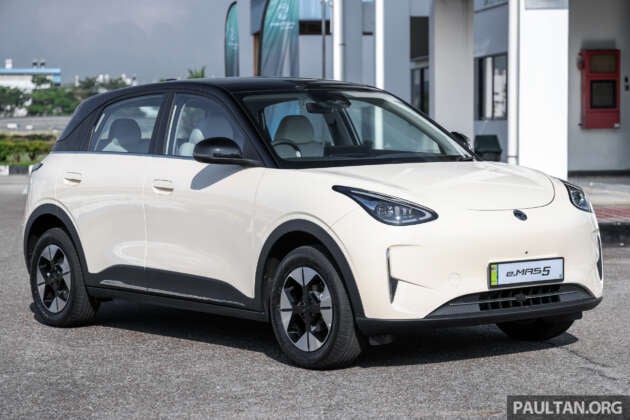
As we’ve learned from comparing the Proton eMas 7 to the X70, an EV is cheaper to maintain than an internal combustion engine (ICE) of a similar size class. That is also true of the eMas 7’s smaller stablemate, the eMas 5, which launched last October and has proven to be a very popular choice among car buyers this year.
Here, we’re comparing the maintenance costs of the eMas 5 to both the Perodua Myvi and Ativa, both of which have already found plenty of buyers in the years since their launch, while being of a similar size class to the eMas 5 and overlapping the EV in terms of price.
In the case of the eMas 5, the base Prime retails for RM56,800 on-the-road without insurance, while the top-spec Premium goes for RM69,800 – these prices are after Pro-Net extended the RM3,000 launch rebate indefinitely. At the Perodua camp, the Myvi ranges from RM50,900 to RM59,900 for the 1.5 litre variants, while the Ativa is priced between RM62,500 to RM73,400.
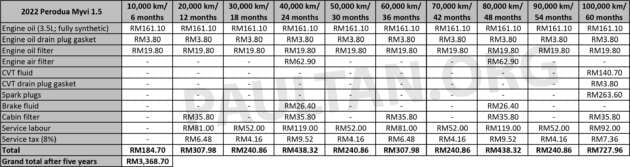
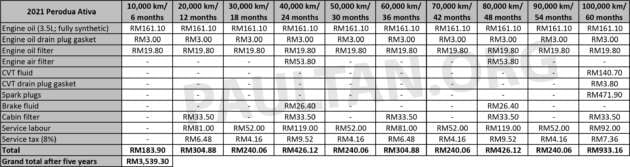
So, how much cheaper is the eMas 5 to maintain when compared to the Peroduas? Over five years, the Myvi will set you back RM3,368.70 and the Ativa will cost RM3,539.30 when referring to Perodua’s official service schedule.
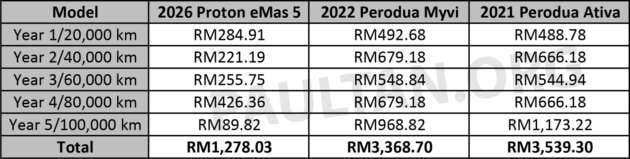
By comparison, the eMas 5 will only cost you RM1,278.03 over five years, which is about 62% and 64% less than the Myvi and Ativa respectively. Keep in mind that the eMas 5’s service intervals differ from the Peroduas, with the first service arriving at 5,000 km/three months, while subsequent ones are every 20,000 km/12 months – the Peroduas’ service interval is every 10,000 km/six months.
When not purely looking across a five-year period, the eMas 5’s complete service schedule actually goes up to 205,000 km/123 months, with the grand total over TEN YEARS being RM2,492.34, which is still less than the Peroduas.
The fewer number of consumables in the eMas 5’s service schedule is the obvious answer to its lower maintenance cost, with listed items being lubricant for the reduction gearbox, brake fluid, coolant and cabin filter. The ICE cars have more items such as engine oil, transmission oil, engine air filter and spark plugs to deal with.
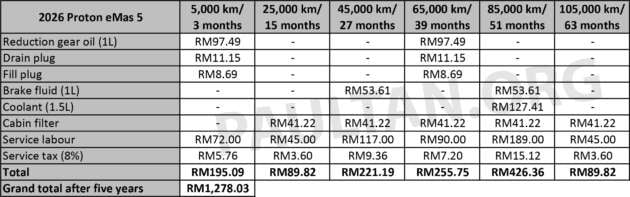

Over five years, the most expensive service cost for the eMas 5 happens at the 85,000 km/51 months mark, where you’ll be paying RM426.36 for everything but a reduction gearbox oil change. For the Myvi, the big bill comes at 100,000 km/60 months where the total cost of the service is RM727.96, while the amount payable for the Ativa is even higher at the same interval at RM933.16, with spark plugs being a big-ticket item.
As always, ownership costs go beyond trips to the service centre. Tyres, for example, are typically pricier as the wheel size goes up. The eMas 5 comes with either 15- (Prime) or 16-inch (Premium) wheels and doesn’t require EV-specific tyres that are generally more costly, while all 1.5 litre variants of the Myvi come with 15-inch wheels. As for the Ativa, its wheels range from 16 to 17 inches.
Based on these wheel sizes, it might be safe to assume that prices of tyres for the eMas 5 is on par with the ICE cars. However, the eMas 5 may experience higher tyre wear due to its instant torque delivery and weight, the latter being between 1,230 and 1,305 kg for the EV. As such, you could be replacing the tyres on an eMas 5 more frequently compared to the Myvi (1,010 to 1,025 kg) and Ativa (1,020 to 1,035 kg).
With regenerative braking via the electric motor, it is likely the eMas 5’s brake pads will last longer compared to the ICE cars. There’s also the matter of road tax, with the eMas 5 costing you either RM30 (Prime) or RM60 (Premium) yearly, while the figure is RM90 for the Myvi and RM20 for the Ativa.
Running an EV should also be significantly cheaper than fuelling up if you charge at home, although your monthly cost might vary if you’re more reliant on public chargers, particularly DC fast chargers that are costlier.
Given the lower cost of maintenance, are you tempted to join the thousands that have already collected their eMas 5? Is there something that is preventing you from making the switch to an EV? Share your thoughts in the comments below.
AD: Drive the Proton model of your dreams. Submit your details and Proton PJ will get in touch with you.
Looking to sell your car? Sell it with Carro.





Main worry is charging it overnight in the car porch. There’s is no plan B if it catches fire while your entire family is deep in sleep upstairs (double storey terrace). Best case is everyone get to escape, but u still have to watch your entire house burn down because we can’t stop the thermal run away
the solution is to buy fire insurance for your house and for your neighbours house.
I’m sure the EV will lose
more RV than the 2K
in comparison
Think again: RV & Battery replacement cost
If that’s how you think then same can be said for emas5 because i can barely see that ugly sin on the road
8 years or 160k km warranty for battery. If battery level lower than 70% you can claim the new one within 8 years.
EV cars have no RV is truth, but you can see ICE car 2nd value drop a lot in these 2 years and thing going to get worse. Because almost every week also got 1 or 2 new cars (EV and ICE) launched and current car model have to fire promotion to sell new cars which launched 2 years ago. Do you think a 5 years old 2nd car value still good?
Proton is not BYD or Tesla, which only manufacture EVs, so it is a bit silly to draw attention to their own ICE competitors’ best-selling ICE vehicles instead of Proton’s own ICE equivalents like the Proton Saga.
If the EMas is cheaper to maintain than their competitors’ entry level ICEs, it will be the same as Proton’s own ICEs, no?
Proton is not BYD or Tesla, which only manufacture EVs, so it is a bit silly to draw attention to their ICE competitors’ best-selling vehicles instead of Proton’s own ICE competitors like the Proton Saga.
Do they really think that if someone is in the market for an Perodua Ativa or Perodua Myvi, they will compare them with the Emas instead of the equivalent model from Proton?
Did they steal the marketing team from Perodua, whose marketing geniuses also compared their QEV to their own Perodua Axia? In their case, I wondered whether they were trying to promote the QEV or knock their own Axia…
Saved so much yet more hi tech and comfortable feels
Not only the maintenace, compared to the other EV too.
A great car for people who don’t travel so much, filled the much needed gap and dream for plush and comfortable car. Strong alternative to Wuling Bingo EV and others.
Time to do indepth analysis into these service charges, eg why Ativa 3-pot spark plugs costing >rm100 ONE piece, coolant 1.5L rm120, even the paper air filter is more than rm60.
Whats happening?
lol is that true? those are literally conti car spare parts prices.
You never go to service center?
That’s the standard price for parts in SC. Even Proton charge almost same price.
Tak suka? Service luar and void the warranty or just paid the cheaper price for fake spare parts
Servicing cost has never been my concern. If I can afford the car, then I can afford the maintenance. My main concern is the charging network. Here in Sarawak, to travel city to city, there are not enough charging station to reduce my range anxiety. I don’t want to change my driving style to adapt the EV style to save my range. And the waiting time for the charging, is not enough to steer me to EV compares to a quick refuel for my long journey.
I want a car that can do everything I need rather than having more than one car.
its a no-brainer for east malauysian to buy pickup truck because they enjoy cheap diesel price thanks to madani generosity
The value comparison is not really complete. Can I suggest also that you make a forecast 2nd hand value of the cars after 5 years. And also the cost of battery change.
Exactly, after 5 yrs what will be the resale value? Considering of after 8 or 10 yrs, for those who don’t replace car frequently. do we need to have the battery replacement issue?
It’s funny that they are comparing the e.MAS 5 with the Myvi and Axia instead of Proton’s own petrol vehicles like the Saga, Persona, and S70.