
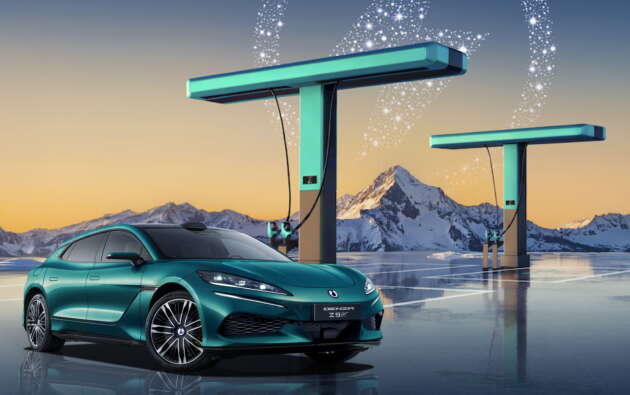
Not long after BYD announced its megawatt Flash Charging technology in China, the Chinese conglomerate confirmed that it would be bringing its innovation to the global market. Autocar has now provided us with the first details of the network, which aims to beat Tesla’s Superchargers in speed and ambition.
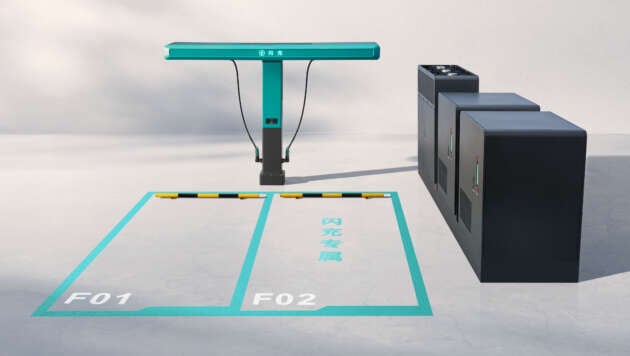
As a refresher, these DC stations – which have T-shaped overhead gantries that emulate petrol stations and allow for charging on either side of the car – will allow compatible BYD and Denza EVs to pull as much as 1,500 kW. As such, they can charge from 10 to 70% (ready to drive, the company claims) in just five minutes and from 10 to 97% (basically a full charge) in nine minutes. This promise extends to the brands’ PHEVs as well, although of course those vehicles will charge at slower rates.
First, the bit that BYD has already declared – it will introduce 6,000 of these stations outside China over the next 12 months, including 3,000 in Europe. This is in addition to the 5,000 already installed in the Middle Kingdom, which is set to expand to a whopping 20,000 stations by the end of the year.
Still, BYD has a mountain to climb to reach Tesla’s installed base of Superchargers, which has reached over 80,000 globally. One advantage that the firm has on its side is that it doesn’t need to build any chargers in the US, given that it still isn’t feasible for Chinese carmakers to sell cars there.
Additionally, the British publication reports that the chargers will be open to non-BYD EV owners and, outside of China at least, will use the European standard CCS2 plug that is already commonplace in Malaysia. According to BYD’s European charging director Diego Pareschi, the company will work with third-party partners to install Flash Charging stations at existing locations.
“We are coming into a mature market [in Europe]. It doesn’t make sense to create your own [locations]. People want a seamless experience and with this they will get that,” he said, adding that the stations will carry Flash branding instead of BYD as the company wants the technology “to be like USB – its own thing.”
To alleviate concerns of such a high-powered charger causing strain on electrical grids everywhere, Flash Charging stations have been configured to enable the use of battery energy storage systems (BESS) instead of drawing directly from the grid. The batteries can be topped up slowly when the stations are not in use, including via solar power. However, just as with BESS stations here, expect charging speeds to slow down significantly once the batteries eventually run out of juice.
Although Flash Charging stations will be open to all EVs, BYD wants to make sure that cars that can actually support the technology can get in and out quickly without being held up by those that charge slower, and it may introduce a Tesla-style “congestion fee”. “We are still figuring out a way to disincentivise people charging at 50 kW. This will be market-dependent, but we might put time caps with penalties.”
The first model to support Flash Charging could already be headed for Malaysia pretty soon – the Denza Z9GT, confirmed for our market, has just been launched in Europe with the technology included. Would you like to see ultra-fast charging on our shores? Let us know in the comments.
Looking to sell your car? Sell it with Carro.





WoW BYD 1.5Megawatts Flash Charging! our VIVO Flash Charging 120W iQoo 10 Pro takes 10 minutes.
commie battery charging tech is far superior to lousy apple or samsung battery
U my good boy writes good comments
Cause u are too jealous right
BYD is d EV king. yet malaysia is ‘boycotting’ BYD
Cause many byd haters in malaysia can’t afford or living in outdated mindset
The global transition toward green energy is gaining significant momentum. While Europe is aggressively expanding its EV sales, Malaysia has achieved a remarkable milestone with 10,000 units sold in just 3months in 2026Q1.
Technologically, while BYD’s Flash Charging is exceptionally fast—capable of reaching a 70% charge in just 5 minutes—it still faces competition from the sheer speed of battery swapping. However, the ‘Powerbank inclusive’ model (mobile charging solutions) offers a highly future-proof alttive. These mobile DC chargers can deploy energy where grid infrastructure is lacking, effectively bridging the gap between convenience and availability.
While the initial 2025 deadline for 10,000 chargers was ambitious, the government has recalibrated its commitment through the National Energy Transition Roadmap (NETR), now aiming for 10,000 points by 2030 with a prioritized rollout of DC fast chargers along major highways. The GITA and GITE (Green Income Tax Exemption) schemes remain active for applications until ..?
China number one
Miti wont allow BYD to implement it.
IN CHINA , NOW NO ONE BUYING BYD . THE SALES DROP SIGNIFICANTLY. CHINESE ARE SMART , THEY ALL BUY TESLA .