
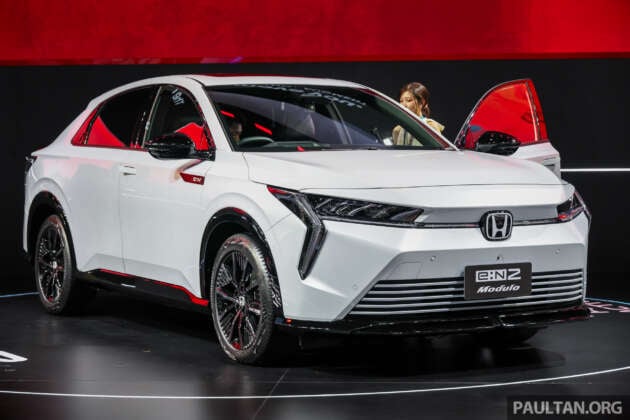
Following the opening of the order books for it earlier this month, Honda Thailand has now officially introduced the e:N2, with the EV going on show at the 2026 Bangkok International Motor Show (BIMS).
Available in only a single grade level (with optional Modulo styling accessories), it’s priced at 1.429 million Baht (RM171,200), which makes it 230,000 Baht (RM27,500) more than the e:N1 (1.199 million Baht, or RM143,700) in Thailand. All e:N2 buyers get a free home charger, and the first 100 customers will also take home a Motocompacto foldable electric scooter worth 65,000 Baht (RM7,780).
The e:N2 is of course the e:NS2 built in China by Dongfeng Honda Automobile and rebadged, identical to the Insight that has been announced for Japan. In Thailand, first deliveries of the electric SUV are expected to begin at the end of April.
Measuring in at 4,788 mm long, 1,838 mm wide and 1,570 mm tall, with a 2,733 mm-long wheelbase, it’s a larger offering than the e:N1 (4,390 mm long, 1,790 mm wide, 1,560 mm tall, with a 2,610 mm wheelbase) and models such as the BYD Atto 3 and Proton eMas 7. Ground clearance is 143 mm, a slight improvement over the 135 mm available on the e:N1.


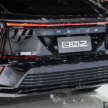
Styling-wise, the car has a slightly more distinctive exterior compared to the e:N1, with design highlights including a fastback-styled roofline and a front end with arrow-shaped LED daytime running lights joined together by a full-width light bar to form a “H” graphic, the design theme repeating at the rear. Additionally, you’ll find recessed pop-out front door handles, hidden rear handles and 18-inch two-tone alloy wheels.
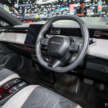
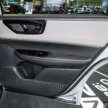
Inside, the cabin presentation is a bit more futuristic than the e:N1’s more traditional depiction, although it’s nowhere as edgy as that found in Chinese competitors. Screens on this one are a 9.4-inch slimline instrument display, a 12.8-inch landscape-oriented infotainment touchscreen running on the latest Honda Connect 4.0 interface, and an 11.5-inch head-up display. The two-tone grey/black interior gets a horizontal orange accent stripe running across the door cards and dashboard to add some extra colour to the interior.
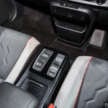
Standard features include power-adjustable front seats (eight-way with memory for the driver, four-way for the passenger) with ventilation, dual-zone auto air con with rear vents, wireless Apple CarPlay and Android Auto, a 12-speaker Bose sound system and an air fragrance system. Also on the kit list are a sunroof, a Qi wireless charger, a 360-degree camera and a hands-free powered tailgate.
It’s powered by the same motor as the e:N1, with the same output numbers coming off the three-in-one unit (which integrates the motor, power drive unit and gearbox), in this case 204 PS (201 hp, or 150 kW) and 310 Nm of torque from 0-4,621 rpm.


The battery is also the same 96-cell 68.8 kWh CATL nickel manganese cobalt (NMC) battery used by the e:N1, but with slightly better range on this one, offering up to 530 km of NEDC-rated range compared to the e:N1’s 500 km (412 km on a WLTP-cycle). Interestingly, the Insight is claimed to be able to manage over 500 km of WLTP-rated movement, so that could have a bigger battery.
Given that it uses the same battery, charging on the e:N2 is likewise identical to the e:N1, with DC CCS2 charging at up to 78 kW taking around 40 minutes to get the battery from a 30% to 80% state-of-charge. It also supports AC charging of up to 6.6 kW, which is slightly lower than the 10 kW rate listed for the Malaysian-spec e:N1.
Safety and driving assistance kit includes seven airbags (including a centre airbag) and a full Honda Sensing suite. As for exterior colour options, three are available, these being Diamond Dust Pearl, Urban Grey Pearl and Crystal Black Pearl. Is the Honda e:N2 heading our way? There has been no indication that it is, and given the RM250k floor price in place for CBU EVs right now, it looks highly unlikely.
GALLERY: 2026 Honda e:N2 (standard and with Modulo kit) at BIMS

















Looking to sell your car? Sell it with Carro.





beza xl saiz
Honda are just built to impress you (it’s hideous) on the showroom floor. No sauce behind that facade, no driving pleasure, no heritage, no proper human engineering. Pure marketing stunt. I’d rather buy a properly made car at the same price, even more, with less power. Buy a car with a soul, not a glorified iPad on wheels. 170K buy a used 2019 Audi A4..
Originality is what makes a car maker great. Copycats don’t earn as much respect.
2 common features of Japan made vehicles:
Firstly, Big loud ugly “logo” stamped on the back of your car. Be it “H” logo ,..
Secondly, weird name… Honda…. cannot understand why such name…
Main worry is parking it overnight in the car porch. There’s is no plan B if it catches fire while your entire family is deep in sleep upstairs (double storey terrace). Best case is everyone get to escape, but u still have to watch your entire house burn down because we can’t stop the thermal run away
Overpriced junk. Once you go China premium EV like the BYD or Zeekr , you never go back to garbage Japan vehicles let alone overpriced turds like these Honda brands arrogantly assuming Asean is a good dumping ground for their unsold trash cans on wheels.