Advertisement

Proton eMas 7 PHEV

  • Proton eMas 7 PHEV gets new Emerald Green colour

    Proton eMas 7 PHEV gets new Emerald Green colour

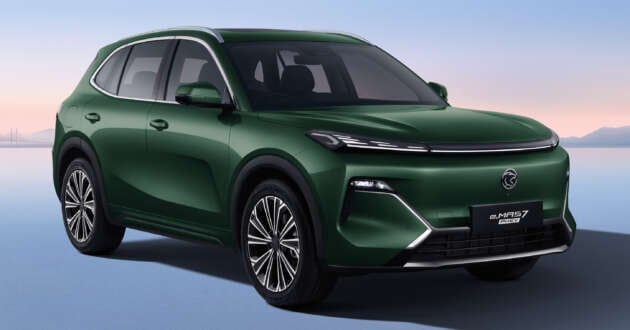
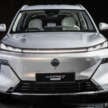
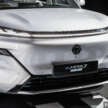
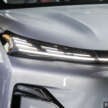
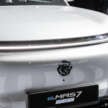
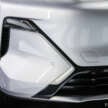
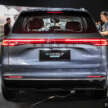
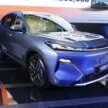
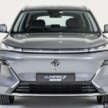
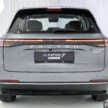
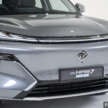
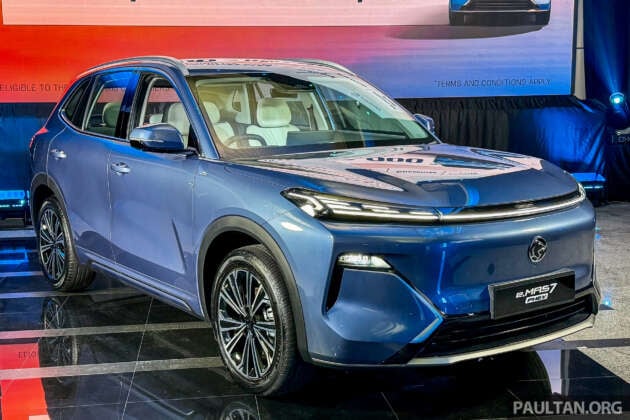
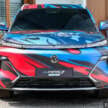
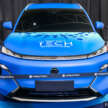
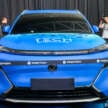
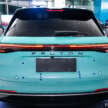
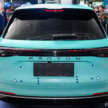
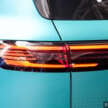
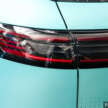
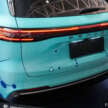
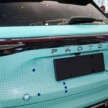
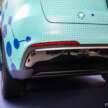
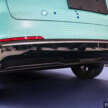
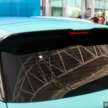
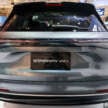
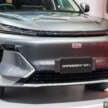
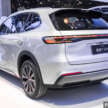
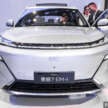
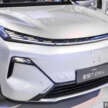
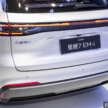
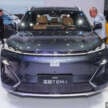
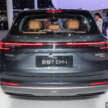
    Nearly two months after going on sale in Malaysia, the Proton eMas 7 PHEV has now gained a new Emerald Green exterior colour. This joins the existing options that include Obsidian Black, Lithium White, Mercury Silver, Galena Grey and Aquamarine Blue.

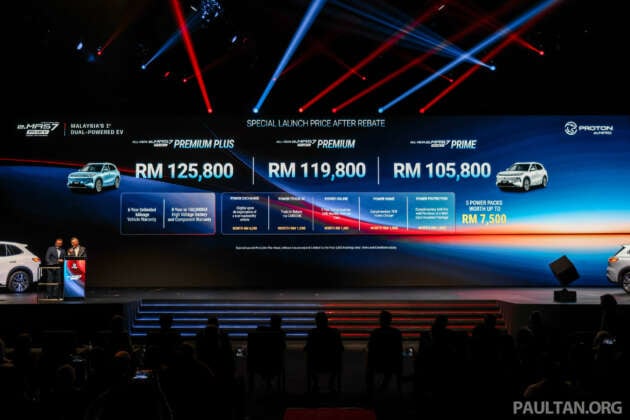
    Pricing for the plug-in hybrid SUV stays the same, with the base Prime going for RM109,800 on-the-road without insurance. This is followed by the Premium at RM123,800, while the range-topping Premium Plus sells for RM129,800. With the RM4,000 launch rebate, the figures are reduced to RM105,800, RM119,800 and RM125,800 respectively.

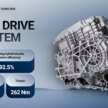
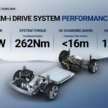
    Powertrain-wise, the eMas 7 PHEV features a 1.5 litre naturally-aspirated inline-four petrol engine serving up 99 PS (98 hp or 73 kW) and 125 Nm of torque. This works with an electric motor rated at 218 PS (215 hp or 160 kW) and 262 Nm for a total system output of 262 PS (259 hp or 193 kW) and 262 Nm that is directed to the front wheels.

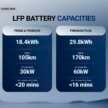
    The Prime and Premium variants come with an 18.4-kWh lithium iron phosphate (LFP) battery from CATL for an electric-only range of 83 km, or 943 km combined hybrid range. Meanwhile, the Premium Plus gets a 29.8-kWh Geely Aegis short blade LFP battery for even more electric-only range at up to 146 km and a higher combined range of 996 km.

    Both the Prime and Premium support DC charging at a peak of 30 kW, with a 30-80% state of charge achieved in under 20 minutes. The Premium Plus’ larger battery can handle up to 60 kW and needs less than 16 minutes to get from 30-80% – a 7-kW onboard AC charger is standard across the range. However, the first two variants take eight seconds to get from 0-100 km/h, with the range-topper requiring 8.2 seconds. All three max out at 170 km/h and come with vehicle-to-load (V2L) and vehicle-to-vehicle (V2V) functions.


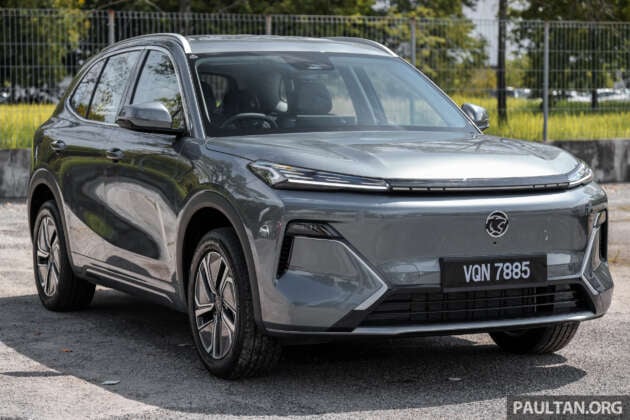
  • 2026 Proton eMas 7 PHEV Prime – gallery of cheapest PHEV in Malaysia; up to 943 km WLTP; RM105,800

    2026 Proton eMas 7 PHEV Prime – gallery of cheapest PHEV in Malaysia; up to 943 km WLTP; RM105,800

    Here’s a full gallery of the Proton eMas 7 PHEV Prime, which is the base variant in the line-up that also includes the Premium and Premium Plus. Priced at RM109,800 on-the-road without insurance, the Prime is RM14,000 less than the Premium and RM20,000 cheaper than range-topping Premium Plus.

    With the RM4,000 launch rebate that is being offered to the first 5,000 customers who book an eMas 7 PHEV, the Prime’s asking price is even lower at RM105,800, making it Malaysia’s cheapest plug-in hybrid model on sale.

    In terms of the powertrain, the Prime is identical to the mid-spec Premium, with a 1.5 litre naturally-aspirated inline-four petrol engine serving up 99 PS (98 hp or 73 kW) and 125 Nm of torque. This works with an electric motor rated at 218 PS (215 hp or 160 kW) and 262 Nm for a total system output of 262 PS (259 hp or 193 kW) and 262 Nm that is directed to the front wheels.

    An 18.4-kWh lithium iron phosphate (LFP) battery from CATL enables up to 83 km of range when running on pure electricity, with the entire system capable of up to 943 km of combined range. The Premium Plus gets a 29.8-kWh Geely Aegis short blade LFP battery for even more electric-only range at up to 146 km and a higher combined range of 996 km.

    Both the Prime and Premium support DC charging at a peak of 30 kW, with a 30-80% state of charge achieved in under 20 minutes. The Premium Plus’ larger battery can handle up to 60 kW and needs less than 16 minutes to get from 30-80% – a 7-kW onboard AC charger is standard across the range. However, the first two variants take eight seconds to get from 0-100 km/h, with the range-topper requiring 8.2 seconds. All three max out at 170 km/h and come with vehicle-to-load (V2L) and vehicle-to-vehicle (V2V) functions.

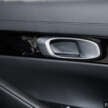
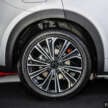
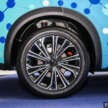
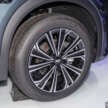
    As for standard equipment, the Prime comes with 18-inch wheels in an aero design, which are an inch smaller than the multi-spoke units on the Premium and Premium Plus – tyres are from Giti (previously Goodyear). In addition to the wheels, another way to spot a Prime is the lack of a full-width light bar between the automatic LED headlamps. The base variant also doesn’t get a panoramic sunroof, auto-folding side mirrors and a powered tailgate.

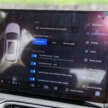
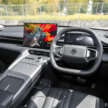
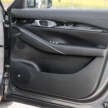
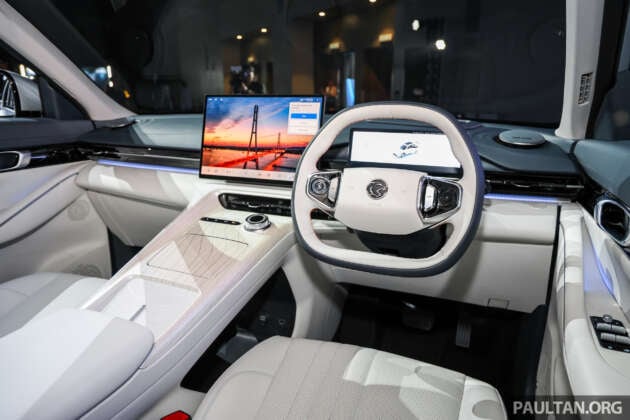
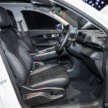
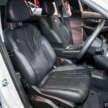
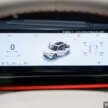
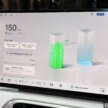
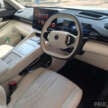
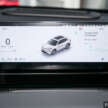
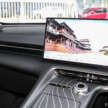
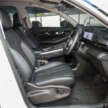
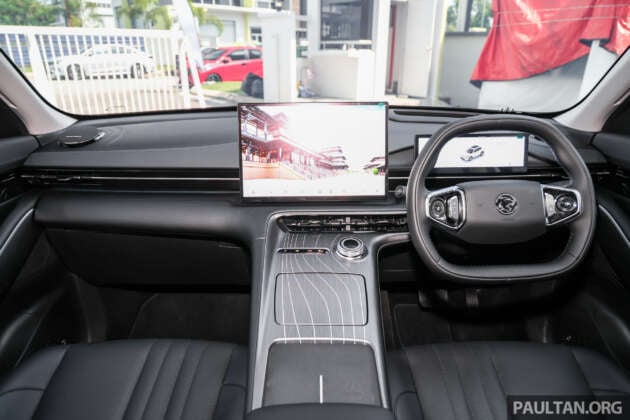
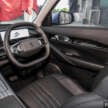
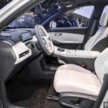
    On the inside, the Prime gets the same 10.2-inch digital instrument cluster as its more expensive stablemates along with leatherette seat upholstery. You still get the 2.5K 15.4-inch infotainment central infotainment touchscreen with Flyme Auto operating system that includes support for Android Auto and Apple CarPlay, app store access, telematics (via the eMas app) and other connected features.

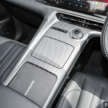
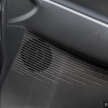
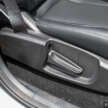
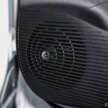
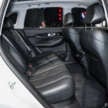
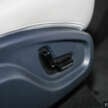
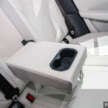
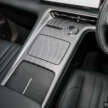
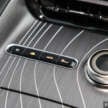
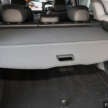
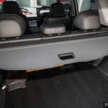
    To meet the price point, things like an auto-dimming rear-view mirror, powered front seats with ventilation, a rear armrest, ambient lighting, a retractable tonneau cover, a head-up display, wireless charging pad and 16-speaker sound system (there’s a six-speaker setup instead) are all absent.

    Click to enlarge

    The suite of safety and driver assistance systems is also not as comprehensive with the Prime, with the base option getting one less airbag (total is six instead of seven), no 360-degree camera (only a reverse camera), no occupant detection alert and no front parking sensors (only rear).

    Additionally, the Level 2 ADAS package is without emergency lane keep assist, rear collision warning, rear cross traffic alert, rear cross traffic automatic braking, lane change safety warning, blind spot detection and door open warning. Even so, you still get key features like adaptive cruise control, automatic emergency braking, forward collision warning, emergency brake assist, lane departure warning, lane departure prevention, lead vehicle departure alert and traffic sign recognition.

    The eMas 7 PHEV comes in Obsidian Black, Lithium White, Mercury Silver, Galena Grey and Aquamarine Blue, while the interior can be had in either Alabaster White or Onyx Black. A six year/unlimited-mileage warranty on the vehicle is included together with an eight-year/160,000-km warranty covering the high-voltage battery and components.


  • Proton eMas 7 PHEV gets 3.5k bookings in 1.5 months

    Proton eMas 7 PHEV gets 3.5k bookings in 1.5 months

    The Proton eMas 7 PHEV has collected over 3,500 bookings in one and a half months. Order books for the plug-in hybrid sister of the eMas 7 EV opened in mid-January ahead of its official launch on February 4.

    Pro-Net, which handles the Proton eMas brand, says that this encouraging booking figure ‘signals very strong market acceptance’. Billed as a practical upgrade from ICE vehicles, the eMas 7 PHEV ‘provides customers with a seamless transition toward electrified mobility while retaining the familiarity and flexibility of a traditional engine platform’.

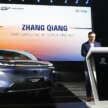
    “Surpassing 5,000 deliveries in just two months and achieving more than 3,500 bookings for the eMas 7 PHEV within one and a half months clearly demonstrate that Malaysians are embracing electrified mobility at an accelerating pace. These results validate our strategy of offering practical, value-driven electrification solutions tailored for the local market,” said Zhang Qiang, CEO of Pro-Net.

    Proton eMas 7 PHEV gets 3.5k bookings in 1.5 months

    “We are humbled by the strong response, but we are equally confident that our focus on building a complete EV ecosystem, from product innovation to ownership support, is what truly differentiates the eMas brand. Our goal is to make electrified mobility accessible, reassuring and relevant for everyday Malaysian families,” he added.

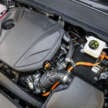
    The eMas 7 PHEV sees a 99 PS/125 Nm 1.5-litre NA engine join forces with a 218 PS/262 Nm front electric motor to send a combined output of 262 PS and 262 Nm of torque to the front wheels. The BHE15-DFN is closely related to the Saga MC3’s engine – still port-injected, it’s been made simpler and lighter for higher efficiency, runs on an Atkinson cycle full time as opposed to part time, has just single instead of dual VVT, and features efficient exhaust gas recirculation (EGR).

    An 11-to-1 electrified dedicated hybrid transmission (E-DHT) combines an integrated starter-generator and a traction motor. The system works similar to Honda’s e:HEV in that the car is driven primarily by electricity but the engine can be clutched in at higher speeds, when petrol power is more efficient.

    Proton eMas 7 PHEV gets 3.5k bookings in 1.5 months

    There are Prime, Premium and Premium Plus variants. The bottom two get an 18.4 kWh CATL LFP battery, an 83 km EV range, 943 km combined range, DC charging up to 30 kW (30-80% in under 20 minutes) and an 8.0-second 0-100 km/h time.

    The range-topping Premium Plus gets a 29.8 kWh Geely Aegis short blade LFP battery for 146 km EV range, 996 km combined range, DC charging up to 60 kW (30-80% in under 16 minutes) and 0-100 km/h in 8.2 seconds. The ICE can charge the battery up to a limit of 85%, and at the other end of the scale, the system protects the battery by not allowing state of charge to dip below 20%.

    The eMas 7 PHEV is priced at RM105,800 for the Prime, RM119,800 for the Premium and RM125,800 for the Premium Plus, on-the-road price without insurance. These RRPs are inclusive of a RM4,000 launch rebate for the first 5,000 customers. Full details and specs here.

    GALLERY: Proton eMas 7 PHEV Premium Plus

    GALLERY: Proton eMas 7 PHEV Premium


  • Proton eMas 7 PHEV features Geely global suspension tune – no Proton involvement in its ride and handling

    Proton eMas 7 PHEV features Geely global suspension tune – no Proton involvement in its ride and handling

    Suspension tuning has always been a source of pride for Proton, best exemplified through the ‘Proton ride and handling’ association. Marrying a high degree of road-going performance with compliance, it’s a badge that has been worn proudly by many of its past offerings, However, that aspect has become less prominent these days, with the element almost all but invisible in marketing chatter coming off the brand. For good reason.

    While products such as the new Saga MC3 still bear some hallmarks of that prowess, the level of involvement from the brand elsewhere has become less pronounced, notably with the brand’s new electrified offerings, with models such as the eMas 5 EV completely eschewing local input in terms of local suspension-related work, with the rebadged version of the Geome Xingyuan/Geely EX2 utilising a global tune from the Chinese automaker.

    The new eMas 7 PHEV continues on that omission path, with the hybrid – which is essentially the Geely Starray EM-i (or Geely Galaxy Starship 7 in China), rebadged as a Proton – not featuring any Proton-based input for its suspension tune. This was first indicated during the static preview of the SUV, and reiterated during the Q&A session held during the media drive of the car last week.

    Proton eMas 7 PHEV features Geely global suspension tune – no Proton involvement in its ride and handling

    According to assistant manager of product marketing David Tiah, Proton was not involved in the tuning of the eMas 7 PHEV’s suspension, with the SUV effectively running a global tune.

    “Regarding the suspension, we did not actually do any specific alterations to it, but the development team used a system called the Virtual Chassis Calibration System. It was developed by other premium brands within the group, and now our cars are using it. What it does is it puts the vehicle set-up through multiple different real-life scenarios, virtually, going through different configurations of chassis tuning to find which is the most suitable,” he said.

    That doesn’t mean that there was no feedback through evaluation from the brand’s end. “For months before the launch, we had our test cars on the road, as shown by spy shots, and during that period, our R&D team, like they do for every car, did heavy testing, running DRT (driver-related testing), quality/reliability and electrical systems testing, putting the car through its paces over thousands of kilometres, including going up Genting and along the East Coast,” he said.

    “All this was so that they could truly evaluate the vehicle to make sure that it fits our roads and our conditions, so that when the car actually gets into the hands of Malaysian drivers, they know that it’s a car that they can truly enjoy driving,” he added.

    With virtual tuning now supposedly able to ascertain the most suitable ride and handling for any particular vehicle, we asked if this meant that things would eventually progress towards the ‘Proton ride and handling’ philosophy being completely omitted in future Proton offerings.

    The answer to that was vague, but suggests that the automaker, away from more “home-grown” products such as the Saga, will likely use suspension calibration defined elsewhere, certainly for all its rebadged models. “Regarding this question per se, I don’t have an answer for you, because these are the decisions that are made by the development team in R&D,” he said.

    Proton eMas 7 PHEV Premium Plus

    Proton eMas 7 PHEV Premium


  • Proton eMas 7 PHEV launched – Malaysia’s cheapest plug-in hybrid, up to 996 km WLTP, RM106k-126k

    Proton eMas 7 PHEV launched – Malaysia’s cheapest plug-in hybrid, up to 996 km WLTP, RM106k-126k

    We’re already exhausted, but Proton’s clearly just getting started. This is the national carmaker’s fourth launch in just 14 weeks, after October’s eMas 5, November’s Saga MC3 and January’s X70 MC3. Well, they do want to sell 200,000 cars this year.

    So here we go (again) – launched today is the Proton eMas 7 PHEV. It’s the first eMas with an engine and an exhaust pipe, and the third eMas model after the 7 (EV) and the 5. The final prices – RM109,800 for the Prime, RM123,800 for the Premium and RM129,800 for the Premium Plus – allow the car to officially snatch away the title of Malaysia’s cheapest plug-in hybrid from the RM130k Chery Tiggo 7 PHEV.

    A RM4,000 rebate for the first 5,000 customers drops the prices to RM105,800, RM119,800 and RM125,800. Warranties? Six years/unlimited mileage on the vehicle, eight years/160,000 km on the high-voltage battery and components. Book the car for RM99 and get RM500 off your booking fee if your car is one of the first 5,000 to be successfully registered. The car is eligible for the government’s matching grant to help you get rid of your old car (RM2,000 each from Proton and the government = RM4,000).
    Proton eMas 7 PHEV launched – Malaysia’s cheapest plug-in hybrid, up to 996 km WLTP, RM106k-126k

    There’s more. You get free 2GB monthly data for five years worth RM1,000, a free 7 kW home charger worth RM1,500, plus complimentary add-ons with the purchase of the eMas Care insurance package worth RM1,000. All these candies are worth up to RM7,500, says the carmaker.

    The Proton eMas 7 PHEV is essentially a Geely EX5/Starray/Galaxy Starship 7 EM-i. Now, Malaysia was the first market outside China to debut the EX5 (eMas 7) and EX2 (eMas 5), but this time, this PHEV is already in a few Oceania and ASEAN markets.

    We are, however, in line with other countries in terms of specs, missing out on the Chinese-market 2026 Galaxy Starship 7’s latest powertrain updates. But it’s still a cutting-edge powertrain – the China-imported (CBU) eMas 7 PHEV sees a 99 PS/125 Nm 1.5 litre BHE15-DFN non-turbo engine join forces with a 218 PS/262 Nm front motor to send a combined output of 262 PS and 262 Nm of torque to the front wheels.
    Proton eMas 7 PHEV launched – Malaysia’s cheapest plug-in hybrid, up to 996 km WLTP, RM106k-126k

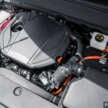
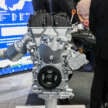
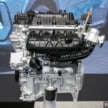
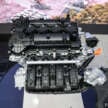
    The petrol engine is closely related to the Saga MC3’s BHE15-CFN. Still port-injected, but it’s been made simpler and lighter for higher efficiency, runs on an Atkinson cycle full time as opposed to part time, has just single instead of dual VVT, and features efficient exhaust gas recirculation (EGR).

    Furthermore, the engine’s lack of an auxiliary belt minimises parasitic losses – no belt-driven air-con compressor and inverter. And like the Saga, it uses a timing chain so there’s no timing belt either. The engine’s thermal efficiency is 46.5% (the latest car in China boasts 47.26%, a higher engine output of 111 PS and 136 Nm of torque and a slightly more powerful motor at 238 PS – but the same 262 Nm of torque).

    An 11-to-1 electrified dedicated hybrid transmission (E-DHT) combines a P1 integrated starter-generator and P3 traction motor. The system works similar to Honda’s e:HEV in that the car is driven primarily by electricity but the engine can be clutched in at higher speeds, when petrol power is more efficient. It’s a series-parallel plug-in hybrid and not an EV, so it’ll have engine size-based road tax and wear black number plates.

    Proton eMas 7 PHEV launched – Malaysia’s cheapest plug-in hybrid, up to 996 km WLTP, RM106k-126k

    The engine can charge the battery up to a limit of 85%, and at the other end of the scale, the system protects the battery by not allowing the state of charge to dip below 20%. The battery is an LFP pack – Proton strongly recommends that customers plug in to fully charge the battery once a week to prolong battery health.

    There are Prime, Premium and Premium Plus variants. The bottom two get an 18.4 kWh CATL LFP battery, an 83 km EV range, a 943 km combined range, DC charging up to 30 kW (30-80% in under 20 minutes) and an eight-second 0-100 km/h time.

    The range-topping Premium Plus gets a 29.8 kWh Geely Aegis short blade LFP battery. Malaysia is unique among global markets in having the larger battery from the 2026 Galaxy Starship 7, and this enables a 146 km EV range, a 996 km combined range, DC charging up to 60 kW (30-80% in under 16 minutes) and an 8.2-second century sprint time.

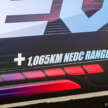
    All ranges quoted above are on the more-realistic WLTP cycle – Proton has, in a departure from usual, chosen to market this model using NEDC figures, clearly to more closely match its rivals. Just for posterity, the combined NEDC ranges are 1,065 km for the Premium Plus and 1,000 km for the Prime and Premium, their corresponding NEDC fuel consumptions are a claimed 4.4 and 4.3 litres per 100 km, and their respective NEDC EV-only ranges are 170 and 105 km.

    Sounds a lot sexier in NEDC, right? But moving from WLTP to NEDC is certainly a backwards step – the former is clearly more realistic and closer to what customers will eventually get in the real world. Proton eMas has long championed the use of WLTP, against most of its NEDC-toting competitors.

    The eMas 7 PHEV has a shorter combined range than the Chery Tiggo 7 PHEV (1,200 km) and Jaecoo J7 PHEV (1,300 km). This is mainly because its fuel tank is smaller at 51 litres versus both Chery Group products’ 60 litres. The Proton has the edge in terms of actual fuel efficiency.

    At 8.0 to 8.2 seconds, the eMas 7 PHEV is slower than its EV sister (6.9 seconds) to 100 km/h, but quicker than the turbocharged Jaecoo and Chery PHEVs (both around 8.5 seconds). And while we’re comparing against those, the eMas 7 PHEV also has the furthest EV range, and quicker DC charging too.

    A 51-litre pressurised fuel tank, 6.6 kW AC charging, 170 km/h top speed, vehicle-to-load (V2L) and vehicle-to-vehicle (V2V) capabilities are common to all variants.

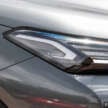
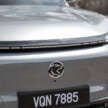
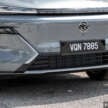
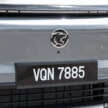
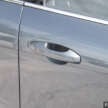
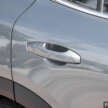
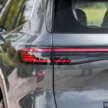
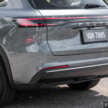
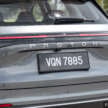
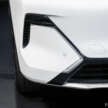
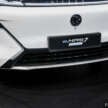
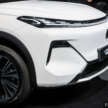
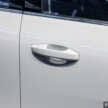
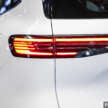
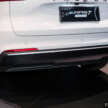
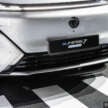
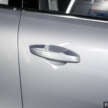
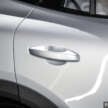
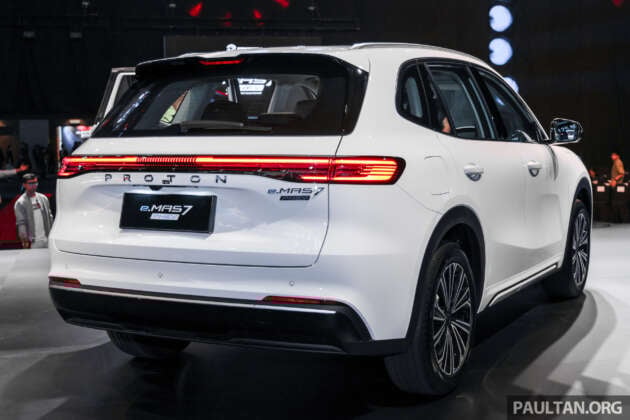
    Exterior-wise, the eMas 7 PHEV differs from the EV in its split headlamps (DRLs above, headlamps below), full-width front LED bar (except Prime), a different front bumper and regular door handles (the EV’s ones are hidden/pop-out/flush/recessed/retractable – whatever you want to call them). The rear number plate’s been moved up from the bumper to the tailgate, allowing a minor rear bumper redesign.

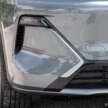
    Wondering if those small front intakes can provide enough cooling? Proton says its local R&D team has done 30,000 km of durability testing in various weather conditions, and its international R&D team has done thermal testing in both winter and summer extremes, and discovered no overheating nor other issues.

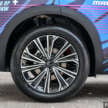
    Same tyre and wheel sizes as the EV (225/55 R18 for the Prime; 235/50 R19 with Goodyear EfficientGrip Performance SUV rubber for the rest), but the PHEV is given a new multi-spoke design. Suspension? Like the EV – MacPhersons up front, multi-links out back. It runs a global set-up; no ‘Proton ride and handling‘. The drag coefficient (Cd) is 0.288, compared to the EV’s 0.275.
    Proton eMas 7 PHEV launched – Malaysia’s cheapest plug-in hybrid, up to 996 km WLTP, RM106k-126k

    Length, width, height and wheelbase are respectively 4,740, 1,940, 1,685 and 2,755 mm, making it 125 mm longer, 39 mm wider and 15 mm taller, and with a 5 mm longer wheelbase, than its EV sister. It’s also slightly larger than both the Chery and Jaecoo.

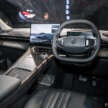
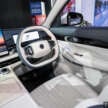
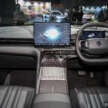
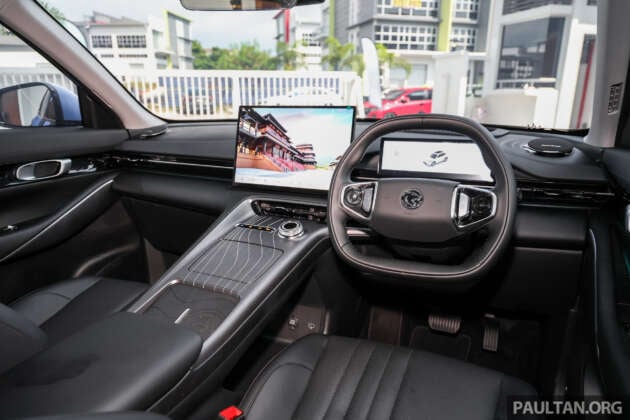
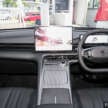
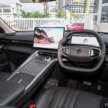
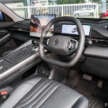
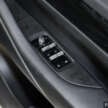
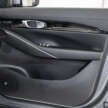
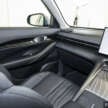
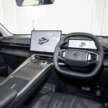
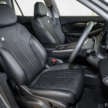
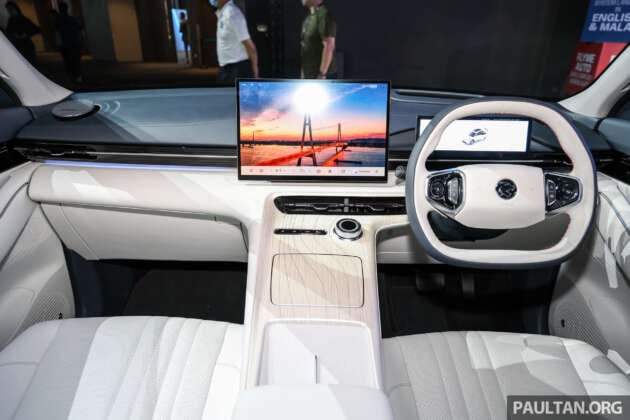
    Interior time. You’ll see that the cabin is pretty much similar to the eMas 7 EV‘s (making CKD easier and cheaper; China’s version has a different cabin) – no matter the variant, you get Flyme OS (with Bahasa Melayu support) powered by a 7nm automotive-grade chip, live charging map integration, a 10.2-inch LCD instrument cluster, a 2.5K 15.4-inch infotainment central touchscreen and leatherette seats.

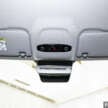
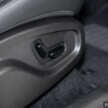
    But unlike the EV, the PHEV gets a tonneau cover (except Prime) and Apple CarPlay/Android Auto from the get-go, plus physical sunroof controls (sunroof only on Premium Plus). To jog your memory, on the EV, you need to go into the screen to operate the sunroof. The button-like front seat backrest inserts have been changed from chrome in the EV to satin silver here to better match the rest of the cabin, but they also lose the small Proton logos that the ones on the EV have.

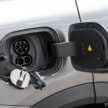
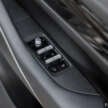
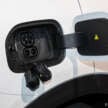
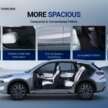
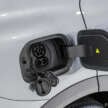
    The fuel flap can be unlocked either via the screen or by holding down the left side mirror control button. The drive modes here are Pure (that’s EV-only mode), Hybrid and Power, compared to the EV’s Eco/Comfort/Sport. Pro-Net says interior space is about the same as the EV – there’s 932 mm hip-to-hip between the front and rear seats, 125 mm of rear knee room and 73.5 mm of rear headroom, the last of which the carmaker says is class-leading.

    Let’s talk about variants and equipment. Literally the only differences between Premium and Premium Plus are the battery, max DC rate and sunroof.

    Both are otherwise equally equipped – powered tailgate, auto-folding side mirrors, auto-dimming frameless rear-view mirror, powered/ventilated front seats, fully-reclinable front passenger seat, rear centre armrest, 256-colour ambient lighting, tonneau cover, 13.8-inch head-up display, wireless charging, 16 Flyme Sound Wanos speakers including in the headrests, auto air-con, seven airbags including a centre airbag (which the Geely Galaxy E5 in China gets and our eMas 7 EV doesn’t), a 360 camera and front parking sensors.

    All the stuff mentioned in the preceding paragraph, the Prime doesn’t get, settling instead for six speakers, six airbags and a reverse camera. It also has the smaller of the two wheels offered and no full-width front LED bar (we’ve yet to clap eyes on this base variant, so what it actually looks like is still a mystery, as is the brand of tyres used – Giti like the eMas 7 Prime EV?).

    In terms of active safety, while all variants get AEB, ACC, ICC, lane functions, leading vehicle departure alert and traffic sign recognition, the Prime omits emergency lane keep assist, rear collision warning, rear cross traffic alert and braking, lane change safety warning, blind spot detection, door open warning and occupant detection alert.

    Pro-Net has been wildly inconsistent with its base variants – you see, the eMas 7 Prime EV has full ADAS while the eMas 5 Prime has no ADAS (although it does have blind spot detection and RCTA). Now, the eMas 7 PHEV Prime has ADAS but no blind spot detection – go figure.

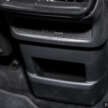
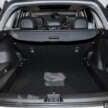
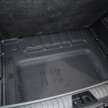
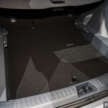
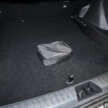
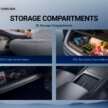
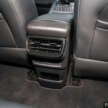
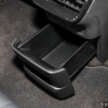
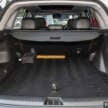
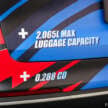
    The boot can take 528 litres; fold down the back seats for 2,065. This is quite a lot more than the EV’s 461 and 1,877 litres. The PHEV’s 100-litre under-boot-floor storage is also 49 litres up on the EV, although it loses the EV’s drawer under the back seats because that’s where the fuel tank is now.

    You can have your eMas 7 PHEV in Obsidian Black, Lithium White, Mercury Silver, Galena Grey or Aquamarine Blue, while the interior can be had in either Alabaster White or Onyx Black (black is new – the eMas 7 EV’s interior is either Alabaster White or Indigo Blue).

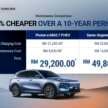
    The service interval is 12 months/20,000 km and according to Pro-Net, the car is 41% cheaper to run over 10 years than a “same-segment ICE SUV” (X70, we guess) at RM29,200 versus RM49,800, including fuel, charging and maintenance. Estimated costs, of course. So what do you think of the Proton eMas 7 PHEV?

    Click to enlarge

    Proton eMas 7 PHEV launched in Malaysia

    Proton eMas 7 PHEV Premium Plus

    Proton eMas 7 PHEV Premium

    Proton eMas 7 PHEV – Aquamarine Blue exterior, Alabaster White interior

    Proton eMas 7 PHEV official photos

    Proton eMas 7 PHEV presentation slides

    Proton eMas 7 PHEV brochure and price list


  • Proton eMas 7 PHEV launching on Feb 4 – 262 PS, up to 146 km EV range, 996 km total, RM110k-130k est

    Proton eMas 7 PHEV launching on Feb 4 – 262 PS, up to 146 km EV range, 996 km total, RM110k-130k est

    Yesterday, Proton announced that its next model, the eMas 7 PHEV, would be launched in ten days, on February 4. That would put it three weeks after the petrol-electric SUV was opened for booking on January 13, during which the car was also fully revealed without any camouflage.

    As a recap, the car carries estimated pricing of between RM110,000 and RM130,000, with three variants – Prime, Premium and Premium+ – set to be offered. The first 5,000 people to book their car (and paying RM99 for the privilege) will receive a RM500 rebate on their booking fee.

    Obviously, the eMas 7 PHEV is a twin of a Geely model, in this case the Starray EM-i. While Malaysia has led the way by being the first market outside China to debut the EX5 (eMas 7) and EX2 (eMas 5), we’re lagging behind slightly this time around, getting the car behind a number of key Oceania and ASEAN markets.

    Proton eMas 7 PHEV launching on Feb 4 – 262 PS, up to 146 km EV range, 996 km total, RM110k-130k est

    We are also in line with other countries when it comes to specs, missing out on the latest powertrain updates for the Chinese-market Galaxy Starship 7 for the 2026 model year. That doesn’t mean that the eMas 7 PHEV is in any way dated, utilising a similarly cutting-edge powertrain as the likes of the Chery Tiggo 7 and 8 PHEV and Jaecoo J7 PHEV.

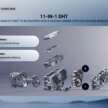
    That means the front electric motor is the predominant force driving the car, producing 218 PS (160 kW) and 262 Nm of torque – same power but less torque than the motor in the eMas 7 EV. This is integrated into the single-speed dedicated hybrid transmission (DHT) that combines 11 components into a single assembly.

    Helping to juice the motor is a 1.5 litre BHE15-DFN naturally-aspirated, port-injected four-cylinder engine, related to the BHE15-CFN mill in the Saga but with single instead of dual variable valve timing, a more efficient exhaust gas recirculation (EGR) system and full-time Atkinson cycle operation, as its priority is on efficient electricity production rather than higher outputs.

    Proton eMas 7 PHEV launching on Feb 4 – 262 PS, up to 146 km EV range, 996 km total, RM110k-130k est

    This is also why the engine has been made simpler and lighter, and while it does make less as a result – 99 PS (73 kW) and 125 Nm – it also results in a thermal efficiency of 46.5% which, until recently, was a world record. While the four-pot is primarily used to top up the battery when it is running low, it can also clutch in to drive the car at higher speeds, contributing to a nicely equal total system output of 262 PS and 262 Nm.

    Speaking of which, the battery is a smaller version of the Aegis short blade LFP unit used in the eMas 7 EV. The Prime and Premium models receive an 18.4 kWh pack that enables a pure electric range of 83 km on the WLTP cycle; with a 51 litre fuel tank, the total range is 943 km. With support for up to 30 kW of DC fast charging, topping up this battery from 30 to 80% will take less than 20 minutes.

    Unlike in other global markets, the Premium+ gains the 29.8 kWh battery only recently introduced on China’s 2026 Galaxy Starship 7. This enables an impressive 146 km of EV range and a total range of 996 km. It will also charge more quickly, with a 60 kW DC charger able to bring the battery from 30 to 80% in under 16 minutes. Fuel consumption is rated – oddly, on the old NEDC cycle – at 4.4 litres per 100 km on the Prime and Premium and 4.3 litres per 100 km on the Premium+.

    Not long to go now until the launch of Proton’s first plug-in hybrid. Are you excited?


  • Proton eMas 7 PHEV open for booking – 3 variants, 2 battery choices, up to 996 km WLTP, RM110k-130k est

    Proton eMas 7 PHEV open for booking – 3 variants, 2 battery choices, up to 996 km WLTP, RM110k-130k est

    You already know all there is to know about the Proton eMas 7 PHEV from a product and variant standpoint, and now, the first eMas with an engine and exhaust pipe (sorry, we don’t think we’re going to call it a “dual-powered EV”) is open for booking in Malaysia. Also, no more camo, so feast your eyes on this avalanche of photos – in the flesh at last!

    The estimated price is between RM110k and RM130k and the launch will be in February ahead of deliveries soon after. Of course, there’s an early-bird package – book the eMas 7 PHEV for just RM99 and get a RM500 booking fee rebate if your car is one of the first 5,000 to be successfully registered.

    Now, because the eMas 7 PHEV isn’t actually launched yet, the RM129,800 Chery Tiggo 7 PHEV is still Malaysia’s cheapest PHEV for now. We expect the final prices to be below the estimated ones, of course, so let’s wait for the launch to officially declare it the country’s most affordable plug-in hybrid.

    Proton eMas 7 PHEV open for booking – 3 variants, 2 battery choices, up to 996 km WLTP, RM110k-130k est

    Essentially a Geely EX5/Starray/Galaxy Starship 7 EM-i, the China-imported (CBU) eMas 7 PHEV sees a 99 PS/125 Nm 1.5 litre BHE15-DFN non-turbo engine join forces with a 218 PS/262 Nm front motor to send a combined output of 262 PS and 262 Nm of torque to the front wheels.

    The petrol engine is closely related to the Saga MC3’s BHE15-CFN. Still port-injected, but it’s been made simpler and lighter for higher efficiency, runs on an Atkinson cycle full time as opposed to part time, has just single- instead of dual-VVT, and features efficient exhaust gas recirculation (EGR).

    Furthermore, the engine’s lack of an auxiliary belt minimises parasitic losses – no belt-driven air-con compressor and inverter. And like the Saga, it uses a timing chain so there’s no timing belt either. The engine’s thermal efficiency is 46.5% – slightly lower than in China, which gets an updated version that’s more efficient and more powerful – 111 PS and 136 Nm of torque.

    An 11-to-1 electrified dedicated hybrid transmission (E-DHT) combines a P1 integrated starter-generator and P3 traction motor. The system works similar to Honda’s e:HEV in that the car is driven primarily by electricity but the engine can be clutched in at higher speeds, when petrol power is more efficient. It’s a series-parallel plug-in hybrid and not an EV, so it’ll have engine size-based road tax and wear black number plates.

    Proton eMas 7 PHEV open for booking – 3 variants, 2 battery choices, up to 996 km WLTP, RM110k-130k est

    The engine can charge the battery up to a limit of 85%, and at the other end of the scale, the system protects the battery by not allowing the state of charge to dip below 20%. The battery is an LFP pack – Proton strongly recommends that customers plug it in to fully charge the battery once a week to prolong battery health.

    There are Prime, Premium and Premium Plus variants. The bottom two get an 18.4-kWh CATL LFP battery, an 83-km EV range, a 943-km combined range, DC charging up to 30 kW (30-80% in under 20 minutes) and an eight-second 0-100 km/h time.

    The range-topping Premium Plus gets a 29.8-kWh Geely Aegis short blade LFP battery, a 146-km EV range, a 996-km combined range, DC charging up to 60 kW (30-80% in under 16 minutes) and an 8.2-second century sprint time.

    All ranges quoted above are on the more-realistic WLTP cycle – Proton has, in a departure from usual, chosen to market this model using NEDC figures, clearly to more closely match its rivals. The combined NEDC ranges are 1,065 km for the Premium Plus and 1,000 km for the Prime and Premium, their corresponding NEDC fuel consumptions are a claimed 4.4 and 4.3 litres per 100 km, and their respective NEDC EV-only ranges are 170 and 105 km.

    Moving from WLTP to NEDC is certainly a backwards step, as the former is clearly more realistic and closer to what customers will eventually get in the real world. Proton eMas has long championed the use of WLTP, against most of its NEDC-toting competitors.

    Where combined range is concerned, the eMas 7 PHEV loses out against the Chery Tiggo 7 PHEV (1,200 km) and Jaecoo J7 PHEV (1,300 km) mainly because its fuel tank is smaller at 51 litres versus 60 for both Chery Group products. In terms of actual fuel efficiency, it’s the Proton that has the edge.

    At 8.0-8.2 seconds, the eMas 7 PHEV is slower than its EV sister (6.9 seconds) to 100 km/h, but quicker than its turbocharged PHEV rivals from Jaecoo and Chery (both around 8.5 seconds). And while we’re comparing against those, the eMas 7 PHEV also has the longest pure EV range, and quicker DC charging too.

    A 51-litre pressurised fuel tank, 6.6 kW AC charging, 170 km/h top speed, vehicle-to-load (V2L) and vehicle-to-vehicle (V2V) capabilities are common to all variants.

    Exterior-wise, the eMas 7 PHEV differs from the EV in its split headlamps (DRLs above, headlamps below), full-width front LED bar (except Prime), a different front bumper and regular door handles (the EV’s ones are hidden/pop-out/flush/recessed/retractable – call ’em whatever you like). The rear number plate’s been moved up from the bumper to the tailgate, allowing a minor rear bumper redesign.

    Wondering if those small front intakes can provide enough cooling? Proton says its local R&D team has done 30,000 km of durability testing in various weather conditions, and its international R&D team has done thermal testing in both winter and summer extremes, and discovered no overheating nor other issues.

    Same tyre and wheel sizes as the EV (225/55 R18 for the Prime; 235/50 R19 with Goodyear EfficientGrip Performance SUV rubber for the rest), but the PHEV is given a new multi-spoke design. Suspension? Like the EV – MacPhersons up front, multi-links out back. It runs a global set-up; no ‘Proton ride and handling‘. The drag coefficient (Cd) is 0.288, compared to the EV’s 0.275.

    Length, width, height and wheelbase are respectively 4,740, 1,940, 1,685 and 2,755 mm, making it 125 mm longer, 39 mm wider and 15 mm taller, and with a 5 mm longer wheelbase, than its EV sister. It’s also slightly larger than both the Chery and Jaecoo.

    Proton eMas 7 PHEV open for booking – 3 variants, 2 battery choices, up to 996 km WLTP, RM110k-130k est

    Interior time. You’ll see that the cabin is pretty much similar to the eMas 7 EV‘s (making CKD easier and cheaper; China’s version has a different cabin) – no matter the variant, you get Flyme OS (with Bahasa Melayu support) powered by a 7nm automotive-grade chip, live charging map integration, a 10.2-inch LCD instrument cluster, a 2.5K 15.4-inch infotainment central touchscreen and leatherette seats.

    But unlike the EV, the PHEV gets a tonneau cover (except Prime) and Apple CarPlay/Android Auto from the get-go, plus physical sunroof controls (sunroof only on Premium Plus). To jog your memory, on the EV, you need to go into the screen to operate the sunroof. The button-like front seat backrest inserts have been changed from chrome in the EV to satin silver here to better match the rest of the cabin, but they also lose out on the small Proton logos that the EV has.

    The fuel flap can be unlocked either via the screen or by holding down the left side mirror control button. The drive modes here are Pure (that’s EV-only mode), Hybrid and Power, compared to the EV’s Eco/Comfort/Sport. Pro-Net says interior space is about the same as the EV – there’s 932 mm hip-to-hip between the front and rear seats, 125 mm of rear knee room and 73.5 mm of rear headroom, the last of which the carmaker says is class-leading.

    Let’s talk about variants and equipment. Literally the only differences between Premium and Premium Plus are the battery, max DC rate and sunroof.

    Both are otherwise equally equipped – powered tailgate, auto-folding side mirrors, auto-dimming frameless rear-view mirror, powered/ventilated front seats, fully-reclinable front passenger seat, rear centre armrest, 256-colour ambient lighting, tonneau cover, 13.8-inch head-up display, wireless charging, 16 Flyme Sound Wanos speakers including in the headrests, auto air-con, seven airbags including a centre airbag (which the Geely Galaxy E5 in China gets and our eMas 7 EV doesn’t), a 360 camera and front parking sensors.

    All the stuff mentioned in the preceding paragraph, the Prime doesn’t get, settling instead for six speakers, six airbags and a reverse camera. It also has the smaller of the two wheels offered and no full-width front LED bar (we’ve yet to clap eyes on this base variant, so what it looks like is still a mystery, as is the brand of tyres used – Giti like the eMas 7 Prime EV?).

    In terms of active safety, while all variants get AEB, ACC, ICC, lane functions, leading vehicle departure alert and traffic sign recognition, the Prime omits emergency lane keep assist, rear collision warning, rear cross traffic alert and braking, lane change safety warning, blind spot detection, door open warning and occupant detection alert.

    Pro-Net has been wildly inconsistent with its base variants – see, the eMas 7 Prime EV has full ADAS while the eMas 5 Prime has no ADAS (although it does have blind spot detection and RCTA). Now, the eMas 7 PHEV Prime has ADAS but no blind spot detection.

    The boot can take 528 litres; fold down the back seats for 2,065. This is quite a lot more than the EV’s 461 and 1,877 litres. The PHEV’s 100-litre hidden underfloor storage is also 49 litres up on the EV, although it loses the EV’s under-seat drawer because that space is now taken up by the fuel tank.

    You can have your eMas 7 PHEV in Obsidian Black, Lithium White, Mercury Silver, Galena Grey or Aquamarine Blue, while the interior can be had in either Alabaster White or Onyx Black (black is new – the eMas 7 EV’s interior is either Alabaster White or Indigo Blue).

    The service interval is 12 months/20,000 km and according to Pro-Net, the car is 41% cheaper over 10 years than a “same-segment ICE SUV” (X70, we guess) at RM29,200 versus RM49,800, including fuel, charging and maintenance. Estimated costs, of course.

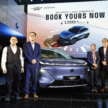
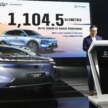
    By the way, Proton successfully completed its two-day live-streamed stunt – a convoy of eMas 7 PHEVs (full tank, full battery) drove from Penang to Johor Bahru and then to Shah Alam before finishing at the Proton COE, covering 1,104.5 km with 189 km range remaining and averaging 4.0 litres per 100 km. It has to be noted that this was achieved with mostly highway driving and may not easily reflect real-world conditions.

    Proton eMas 7 PHEV open for booking – 3 variants, 2 battery choices, up to 996 km WLTP, RM110k-130k est

    Click to enlarge

    Proton eMas 7 PHEV – Aquamarine Blue exterior, Alabaster White interior

    Proton eMas 7 PHEV Premium

    Proton eMas 7 PHEV Premium Plus interior

    Proton eMas 7 PHEV official photos

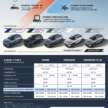
    Proton eMas 7 PHEV presentation slides


  • Proton eMas 7 PHEV full specifications revealed – 262 PS/262 Nm, two LFP battery sizes, up to 996 km WLTP

    Proton eMas 7 PHEV full specifications revealed – 262 PS/262 Nm, two LFP battery sizes, up to 996 km WLTP

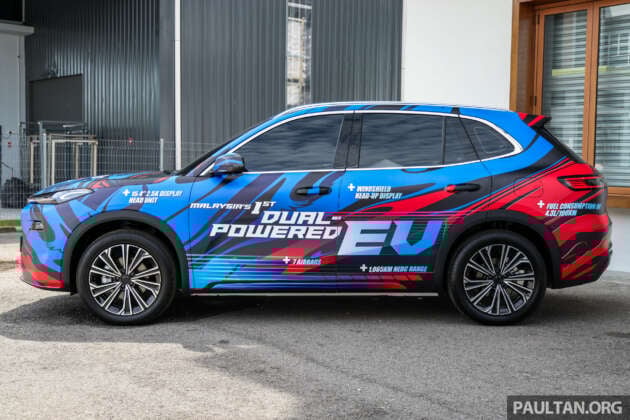
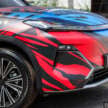
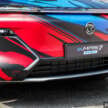
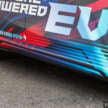
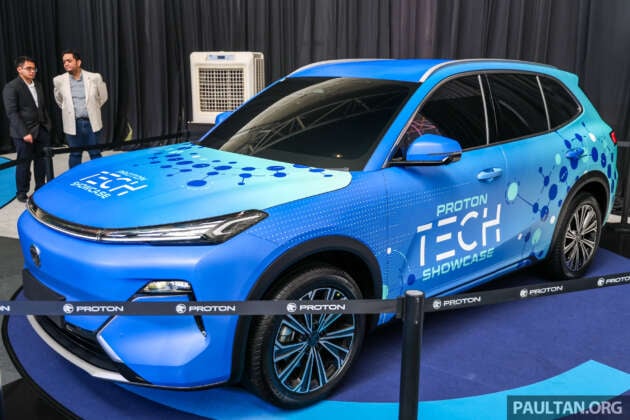
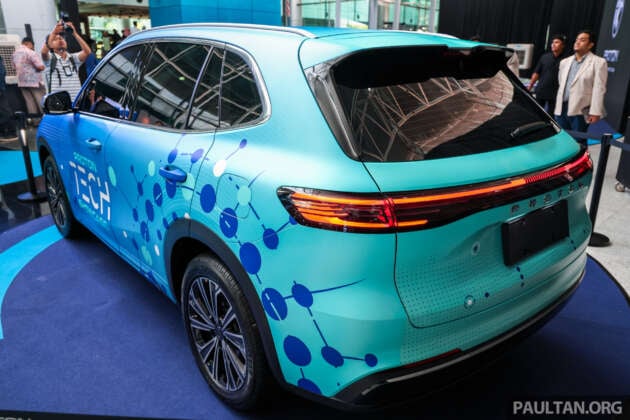
    A month after it was first shown at the Proton Tech Showcase at the Centre of Excellence (COE), the Proton eMas 7 PHEV has gone on show again, this time at a dedicated media preview held for it last week. As it was in December, the automaker’s first-ever plug-in hybrid remains hidden under camouflage, but with a different wrap, one that presents technical highlights of the SUV in points across the scheme.

    Some reconfirm things already known, but there are new bits, and it would have provided a neat hint of what to expect, had the company not also decided to allow the release of the complete specification sheet for the vehicle and make all technical details available, which makes what’s on the wrap moot for the most.

    As such, we’ll present all that we know about the P145, which the company is badging as “Malaysia’s first dual-powered EV.” Hafriz has made his point about this, so I won’t delve further on what is essentially a liberal marketing term coined for it.

    Same as, but different

    Proton eMas 7 PHEV full specifications revealed – 262 PS/262 Nm, two LFP battery sizes, up to 996 km WLTP

    Before we get to the details, let’s recap the eMas 7 PHEV. Like how the fully-electric eMas 7 is the Geely Galaxy E5/EX5 with a Proton badge, the PHEV is essentially the Geely Starray EM-i (or Geely Galaxy Starship 7 in China), badged as a Proton.

    That done, on to the specs. It measures in at 4,740 mm long, 1,940 mm wide and 1,685 mm tall, with a 2,755 mm-long wheelbase, which makes it 125 mm longer, 39 mm wider and 15 mm taller than the eMas 7 EV (4,615 mm long, 1,901 mm wide and 1,670 mm tall), and its wheelbase is also five mm longer than the electric.

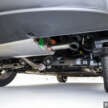
    At the presentation, the automaker highlighted that the GMA platform employed for the PHEV features five dedicated layout pathways to provide independent isolation of fuel, electrical and exhaust systems as well as six transverse/four longitudinal fuel/electric protective beams and six full 360-degree protection zones to deliver maximum external protection for the fuel tank and battery pack. Additionally, a three-layer stepped design for the underbody reduces the risk of scraping damage to the battery, which doesn’t jut out beneath the car à la the e:N1.

    Proton eMas 7 PHEV full specifications revealed – 262 PS/262 Nm, two LFP battery sizes, up to 996 km WLTP

    Looks-wise, its exterior is largely similar to the electric eMas 7, but a number of styling elements help present it with a more conventional – and arguably, more handsome – look, which you’ll get to see in full very soon. The front end, with split headlights and a full-width LED light bar running between them as well as a more defined bumper, gives the hybrid a bit more visual presence and dimensionality. Mention was made that the PHEV’s headlamps have been lowered to reduce glare.

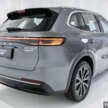
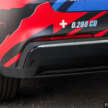
    Other differences include conventional door handles instead of the recessed, pop-out items on the electric and a reworked rear end, which sees the number plate placement being moved up from the bumper to the tailgate, lending it strong Porsche Cayenne overtures when viewed from the rear quarters. All this, without significant detriment to its resistance on the move, its 0.288 Cd not far away from the eMas 7 EV’s 0.275 Cd.

    While it also rides on 18-inch (Prime) and 19-inch alloys (Premium and Premium Plus) like the EV, the PHEV features a new multi-spoke wheel design. Tyre profiles are identical to the EV across both wheel sizes – 225/55 profile units on 18s, and 235/50 on the 19s.

    Like the eMas 7 EV, the suspension consists of front MacPherson struts and rear multi-links, and the set-up for it is the same as global models. Asked if there was any Malaysian touch to ride and handling for it, the answer from Pro-Net was no, but it was indicated that there was some involvement early on in the project.

    As for exterior colours, five are available for the eMas 7 PHEV, and these are Obsidian Black, Lithium White, Mercury Silver, Galena Grey and Azure Blue.

    Variants, powertrains and batteries

    The PHEV follows the variant naming convention of the EV, but adds on one more to make it three – the Prime, Premium and a Premium Plus. All will feature Geely’s EM-i (for E-Motive Intelligence) Super Hybrid powertrain, which consists of:

    • A 99 PS (98 hp, or 73 kW) and 125 Nm 1.5 litre naturally-aspirated engine
    • A 218 PS (215 hp, or 160 kW) and 262 Nm front motor
    • Total power output is rated at 262 PS (258 hp, or 193 kW) and 262 Nm, all sent to the front wheels

    Proton eMas 7 PHEV full specifications revealed – 262 PS/262 Nm, two LFP battery sizes, up to 996 km WLTP

    The petrol mill, BHE15-DFN, is an Atkinson-cycle version of the 1.5 litre BHE15-CFN, which made its debut in the new Saga MC3. For its application here, the naturally-aspirated unit has been made simpler and lighter for higher efficiency – single instead of dual-VVT and efficient EGR (exhaust gas recirculation) at the back. Anoraks will note that the output is down from the Chinese market’s 111 PS and 136 Nm engine.

    It was earlier mentioned that the engine has a thermal efficiency of 47.26%, which is claimed by Geely to be the best in the world for a mass produced internal combustion engine. It has been revised to 46.5%, as noted on the info point placed on the hood – the reason why it’s slightly lower than China is because the latter gets the updated version, which is slightly more efficient, the company says.

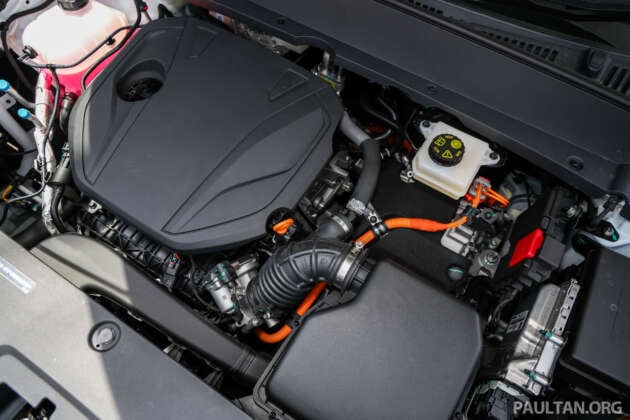
    As highlighted in the first preview, the engine doesn’t use an auxiliary belt, with minimal parasitic loss as a result. Elsewhere, the AC compressor is electric and the car’s 12V battery is charged via a DC-DC converter instead of an alternator, and the water pump has a higher capacity compared to the version in the Saga. The fuel tank is also pressurised on the PHEV.

    Mated to the mill is an 11-to-1 electrified dedicated hybrid transmission (E-DHT) that combines a P1 integrated starter-generator and P3 traction motor. The system mostly lets the motor power the wheels on its own, but it has the ability to engage a clutch and feed in the ICE’s power at higher speeds where the engine is more efficient, similar to Honda’s e:HEV (non plug-in) hybrid system.

    Performance figures include a 0-100 km/h sprint time of 8.0 seconds for the Prime/Premium and 8.2 seconds for the same on the Premium Plus, with all three variants having the same 170 km/h top whack. Besides this, the variants differ in battery capacities, range and DC charging rates. Like the EV, the PHEV features two batteries of different capacities and performance, and they are:

    • Premium Plus – 29.8 kWh Aegis short blade lithium iron phosphate (LFP) battery, 146 km EV range, 996 km combined (both WLTP), 60 kW DC charging (30-80% SoC in under 16 minutes), 6.6 kW AC
    • Premium and Prime – 18.4 kWh CATL LFP battery, 83 km EV range, 943 km combined (both WLTP), 30 kW DC charging (30 to 80% SoC in under 20 minutes), 6.6 kW AC

    You’ll note from the specification sheet – and the point highlight on the camo car – that the PHEV offers 1,065 km of combined range on the Premium Plus (and 1,000 km for the Prime and Premium), but that’s based on the more lenient NEDC cycle.

    Now, being able to tout 1,000 km or more of range is obviously neat from a marketing viewpoint (and a drive livestream event), but it’s simply following on the path that some competing offerings have gone, and in any case it would be a stretch to have drivers achieve this each and every time over a lifetime of mixed cycle use, where really nothing ever follows what’s listed on the tin.

    More importantly, it also moves away from the automaker’s positive use of more realistic range permutations for its EV offerings, and so, it’s with WLTP that we present the PHEV’s theoretical range. In any case, the WLTP numbers aren’t anything to scoff at, given that the range topper is just a shade off the 1k mark.

    Proton eMas 7 PHEV full specifications revealed – 262 PS/262 Nm, two LFP battery sizes, up to 996 km WLTP

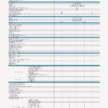
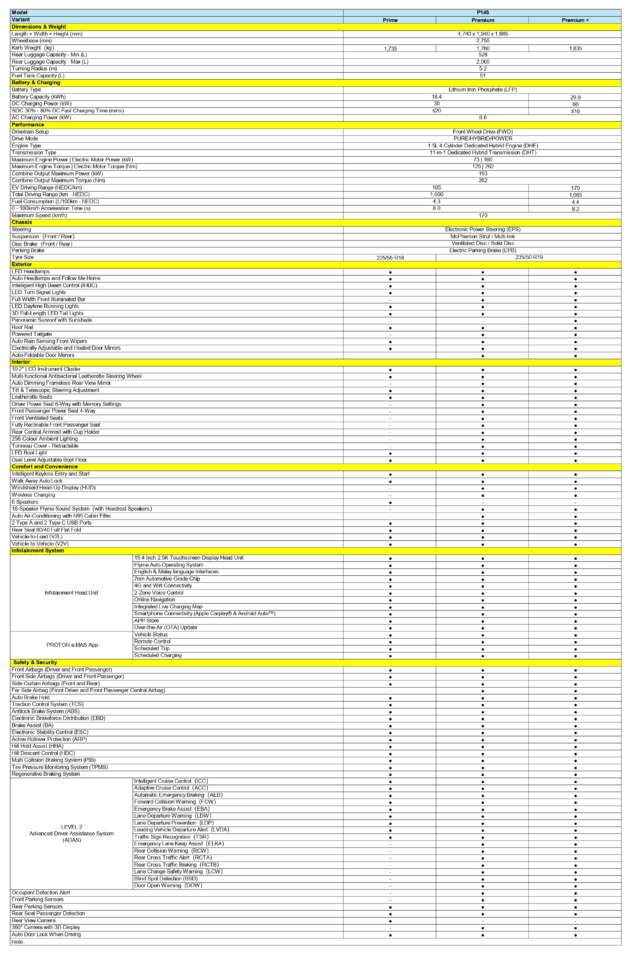
    Proton eMas 7 PHEV specification sheet. Click to enlarge.

    The eagle-eyed reader will have noted that the range-topping PHEV variant’s DC charging of up to 60 kW is lower than the eMas 7 EV’s 80 kW and 100 kW rate, but this is hardly a thing, given its smaller battery capacity and PHEV leanings.

    Meanwhile, fuel consumption is listed as 4.3 litres per 100 km on the Prime/Premium and 4.4 litres/100 km on the Premium Plus, but that’s on NEDC, so you can expect it to be higher in the final count. As for the PHEV’s service interval, it’s 12 months or 20,000 km, and during the preview, the automaker stressed that the service cost for it sits in between ICE and EV, with things hedging closer to EV.

    Interior and kit

    We can’t offer a view of the interior as yet, but that will come very soon. However, you can expect a cabin presentation identical to the eMas 7 EV (which in the image below provides a visual indication of what’s coming), with right-hand-drive cars retaining the eMas 7’s dashboard instead of the one seen in the domestic market LHD Starship 7. The reason for this is for cheaper localisation, with more common parts being shared. Incidentally, the eMas 7 PHEV launches as a CBU first before local assembly gets underway.

    Proton eMas 7 PHEV full specifications revealed – 262 PS/262 Nm, two LFP battery sizes, up to 996 km WLTP

    Proton eMas 7 EV interior. Click to enlarge.

    In terms of equipment, the PHEV’s kit list reads like the one for the all-electric eMas 7, and so you’ll find a Flyme OS (with English and Malay language support) powered by a 7nm automotive grade chip, live charging map integration, 10.2-inch LCD instrument cluster, a 2.5K 15.4-inch infotainment central touchscreen and leatherette seats as standard fare. Apple CarPlay and Android Auto is available on the PHEV from the get-go.

    Variant specific equipment also generally mirrors that of the EV, from the six-speaker audio system on the Prime and 16-speaker Flyme Sound Wanos system on the Premium (and here, the Premium Plus) to the 13.8-inch windshield head-up display on higher variants. The Prime PHEV omits the powered driver’s seat found on the Prime EV, but the adjustment scope on powered seats up the model range is identical to the EV.

    There are some differences. The eMas 7 PHEV has physical sunroof controls (on-screen on the EV) and a built-in tonneau cover, and it has a higher airbag count than the EV, seven to the six on the latter with the inclusion of a central airbag between the driver/front passenger, so it’ll be interesting to see if these improvements will filter down to the EV for the next update.

    Naturally, boot space is also up from the EV. The PHEV offers 528 litres of rear volume capacity, expandable to 2,065 litres with the rear seats folded, giving it 67 litres and 188 litres more than the EV (461 litres, 1,877 litres). Its 100 litres hidden underfloor storage is also 49 litres more than the 51 litres available for the EV.

    Some other spatial numbers were mentioned during the presentation, such as the 932 mm hip to hip distance between front and rear seats, 125 mm of rear-seat knee room and 73.5 mm of rear headroom, the last of which the automaker says is class-leading. According to Proton, interior space is about the same as the EV.

    We’ll have more on the Proton eMas 7 PHEV very soon, including what it looks like uncovered, so stay tuned.

    GALLERY: 2026 Proton eMas 7 PHEV at Proton Tech Showcase

    GALLERY: RHD Geely Starray EM-i at GIIAS 2025


  • Proton eMas 7 PHEV teaser – “dual-powered EV” to do Penang – JB – Shah Alam 1,000 km drive livestream

    Proton eMas 7 PHEV teaser – “dual-powered EV” to do Penang – JB – Shah Alam 1,000 km drive livestream

    It’s now official, Pro-net’s upcoming model is simply named the Proton eMas 7 PHEV, and it will be launched very soon. Proton eMas has just published the teaser you see here on its social media pages, showing the upcoming plug-in hybrid in a new blue and red wrap design alongside its claim of being “Malaysia’s 1st Dual-powered EV.”
    The post also announces the “ultimate live – drive” where the eMas 7 PHEV will be livestreamed doing a 1,000-km drive from Penang to JB, and then back to the Proton Centre of Excellence in Shah Alam over January 12 and 13 (Monday and Tuesday in the coming week). The convoy will be stopping by local attractions and Proton eMas dealerships, so you could catch an early glimpse of it along the way (stops and timing shown below).

    Obviously, the drive is to demonstrate the new model’s “exceptional range of over 1,000 km,” though it has to be said that other similarly sized China plug-in hybrid models like the Chery Tiggo 7 PHEV and Jaecoo J7 PHEV will easily do the same journey too, with both having over 1,200 km NEDC range claims.

    Speaking of that, Proton’s over 1,000 km claim for the eMas 7 PHEV is a peculiar one, as the Australian-market Geely Starray EM-i (also known as the Galaxy Starship 7 in China, the donor model this is rebadged from) only claims a maximum combined WLTP range of 943 km. Whether the eMas 7 PHEV will be offered with a larger battery pack (available in China) or if Proton will revert to the more lenient NEDC test cycle claim to more closely match its Chinese rivals, or perhaps both, remains to be seen.

    If Proton is indeed moving towards the use NEDC range claims for this model, that would truly be a backwards step. The Proton eMas brand has so far been one of the strongest stalwarts of using the more realistic WLTP test cycle in Malaysia, going against most Chinese EV-makers that prefer the use of overly optimistic NEDC claims (one even uses wildly inaccurate CLTC numbers) that would look better on paper. Why change now?

    On the subject of questionable decisions, let’s get back to the tagline of “Malaysia’s 1st Dual-powered EV.” I’m sorry Pro-net, but that’s just wrong on so many levels. This is a PHEV, not an EV – its road tax will be based on its engine size like a regular ICE car and not its motor output like proper EVs, and it will wear the standard black number plates, not the EV-specific white ones. Marketing it as an EV is simply misleading.

    As for it being Malaysia’s first, well, that’s just not right either. PHEVs have existed here since as far back as 2015, though admittedly only in premium segments until the two Chinese models mentioned above arrived last year. If the tagline is meant to signify it being the first “Malaysian” PHEV, well, that would be a contentious claim too given its rebadged nature.

    The Geely Starray EM-i or Starship 7

    On a more positive note, look closely at the livery and you’ll just about make out the mention of seven airbags, so it appears the eMas 7 PHEV will gain back the front centre airbag that was dropped from the EV version. That would be a proper Proton-first, and a welcome addition indeed.

    We will have more details on the Proton eMas 7 PHEV very soon, so stay tuned!

    GALLERY: 2026 Proton eMas 7 PHEV at Proton Tech Showcase

    GALLERY: RHD Geely Starray EM-i at GIIAS 2025


  • Proton eMas 7 PHEV previewed – first plug-in hybrid by P1 based on Geely Starray EM-i, priced fr RM130k?

    Proton eMas 7 PHEV previewed – first plug-in hybrid by P1 based on Geely Starray EM-i, priced fr RM130k?

    As teased, Proton has unveiled the upcoming Proton eMas 7 PHEV for the first time at the Proton Tech Showcase, which opens to the public tomorrow at Proton’s Centre of Excellence (COE) in Shah Alam. Upcoming because this isn’t yet a launch, but a preview of the carmaker’s first ever plug-in hybrid.

    It’s no secret that the eMas 7 PHEV is a Proton-badged Geely Starray EM-i a.k.a. Geely Galaxy Starship 7 in China, just like how the fully-electric eMas 7 is basically the Geely Galaxy E5/Geely EX5. Speaking of logos, Proton’s tiger badge is not just found on the nose of this PHEV (larger here than on the EV), but this right-hand-drive demo car’s glass panels as well – the latter is a hint that this unit is close to the production car and the launch should not be too far away.

    Proton’s first PHEV will feature a version of the 1.5 litre BHE15PFI that has already made its debut in the new Saga. Here, the naturally-aspirated four-cylinder PFI unit is made simpler and lighter for higher efficiency – single instead of dual-VVT and efficient EGR (exhaust gas recirculation) at the back. Of course, it runs full-time on the efficient Atkinson cycle.

    Proton eMas 7 PHEV previewed – first plug-in hybrid by P1 based on Geely Starray EM-i, priced fr RM130k?

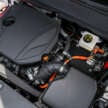
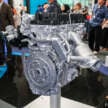
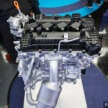
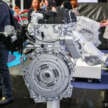
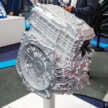
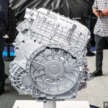
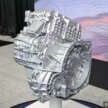
    The powertrain, which is also on display here, does not use an auxiliary belt and there’s minimal parasitic loss as a result. The AC compressor is electric and the car’s 12V battery is charged via DC-DC converter instead of an alternator. The water pump has a higher capacity compared to the version in the Saga.

    All global markets get Geely’s EM-i (for E-Motive Intelligence) Super Hybrid powertrain with a 99 PS/125 Nm engine and a 218 PS/262 Nm front motor. This is a step below the Chinese market’s 111 PS/136 Nm engine. The 0-100 km/h sprint is done in eight seconds flat.

    The engine has a thermal efficiency of 47.26%, which is claimed by Geely to be the best in the world for a mass produced ICE. According to a powertrain expert from Geely who made the presentation today, contributing factors include very efficient combustion (burning speed increased by 20%), tumble ratio that’s increased by 21% and 44% better turbulent kinetic energy.

    The PHEV’s battery is an 18.4 kWh Aegis short blade lithium iron phosphate (LFP) unit (less than the 19.09 kWh pack in China’s Starship 7) and it powers the above-mentioned e-motor, which is housed in a 12-in-1 single-speed dedicated hybrid transmission (DHT). The system mostly lets the motor power the wheels on its own, but it has the ability to engage a clutch and feed in the ICE’s power at higher speeds where the engine is more efficient – this is like Honda’s e:HEV (non plug-in) hybrid system.

    Finally, range. With the 18.4 kWh battery, the total range claimed by Proton in today’s presentation is 1,065 km, which has to be from a lenient cycle. The Australian-spec Starray EM-i is quoted with 83 km pure EV range and overall range of 943 km, both on the benchmark WLTP cycle.

    The eMas 7 PHEV is largely similar to the electric eMas 7 on the outside, but it’s a fair bit more handsome to these eyes thanks to a more ‘filled up’ front fascia, which sports split headlights with a full-width LED light bar on top. Other differences include conventional door handles instead of flush pop-out items, bumpers and the tailgate/tail lamp design. With the number plate moved up, the PHEV looks even more like a Porsche Cayenne. The 19-inch alloys (unchanged size) have a multi-spoke design, and of course, there an extra flap on the side for charging.

    Other observations based on this display unit include the Hangzhou West Lake print on the edge of the windscreen and a panoramic sunroof that’s well camouflaged by the blue wrap. Inside, right-hand-drive cars get the eMas 7’s dashboard instead of the one seen in the domestic market Starship 7.

    What do you think of the Proton eMas 7 PHEV’s looks and tech package? Would you pay RM130k for it? While Proton did not share any estimated price at today’s event, selected Proton X50 owners have received survey forms for the upcoming PHEV SUV. In it, one question asks if they would consider buying the eMas 7 PHEV if it was priced around RM20-30k above their car.

    Given that the latest X50 – launched in July this year – is priced from RM85,800 to RM109,300 for the Flagship, and that the eMas 7 PHEV is expected to have all the kit of the range-topping X50 (and then some), would the eMas 7 PHEV have a price of between RM130k to RM140k? That’s costlier than the fully-electric eMas 7, but bear in mind that CKD EVs are tax-free now and will remain to be so from next year, while PHEVs do not have this perk. Would you be willing to pay more for this PHEV over the EV?

    GALLERY: 2026 Proton eMas 7 PHEV at Proton Tech Showcase

    GALLERY: RHD Geely Starray EM-i at GIIAS 2025


  • Proton eMas 7 PHEV survey sighted – plug-in hybrid version of SUV to be priced from RM130k to RM140k?

    Just prior to the anticipated preview of the Proton eMas 7 PHEV at the Proton Tech Showcase to be held at the Proton Centre of Excellence (COE) showroom in Shah Alam this weekend, it appears that current Proton owners have received survey forms for the upcoming plug-in hybrid SUV model.

    According to a question within the survey, it appears that the eMas 7 PHEV could be priced around RM20-30k above the Proton X50, which was launched in July this year, priced from RM85,800 to RM109,300 for the Flagship variant. Given the preview of the eMas 7 PHEV is of Flagship-level specification, the RM20-30k gap could mean the eMas 7 PHEV is estimated to be priced between RM130k-140k.

    Should the pricing for the eMas 7 PHEV materialise as such, the plug-in hybrid version of the SUV would be priced nearly identically to the eMas 7 BEV, which was introduced at RM105,800 after the launch package discount.

    Proton eMas 7 PHEV survey sighted – plug-in hybrid version of SUV to be priced from RM130k to RM140k?

    Most recently sighted on test in Malaysia last month, the eMas 7 PHEV in other right-hand-drive markets is known as the EX5 EM-i in Australia, and as the Starray EM-i in Indonesia, starting as the Galaxy Starship 7 EM-i in its native China.

    The eMas 7 PHEV will pack a detuned version of the 1.5 litre BHE15PFI naturally-aspirated four-cylinder that made its debut in the latest Saga that was launched last week.

    Based on right-hand-drive export models this powertrain is likely to be a 99 PS/125 Nm engine paired with a 218 PS/262 Nm motor, drawing from an 18.4 kWh battery. Thus equipped, claimed EV range is 83 km, with an overall range of 943 km (figures based on WLTP protocol).

    Externally, the eMas 7 PHEV will be mostly similar to the battery electric version currently on sale, save for differences in the headlamps which feature a full-width light bar, conventional door handles in place of the flush pop-out units on the BEV, different bumper and tailgate designs, and tail lamps.

    GALLERY: Proton eMas 7 spyshots

    GALLERY: RHD Geely Starray EM-i at GIIAS 2025


  • Proton eMas 7 PHEV teased, set to debut at Proton Tech Showcase, COE, Dec 5-7 – 83 km EV, 943 km total

    Proton eMas 7 PHEV teased, set to debut at Proton Tech Showcase, COE, Dec 5-7 – 83 km EV, 943 km total

    Having launched three new cars this year (the facelifted X50, the eMas 5 and the Saga), you might think that Proton would put its feet up and take a well-deserved break. But you’d be wrong – the national carmaker is holding a Proton Tech Showcase at its Centre of Excellence (COE) showroom in Shah Alam this weekend, and the company’s social media posts tease a brand new SUV making an appearance.

    As you can see, the general shape is very similar to the eMas 7, but while the vast majority of the car has been blacked out, the illuminated taillights with their C-shaped corners immediately mark it out as something different. That’s right – you’re looking at none other than the PHEV version, which has already been spotted undergoing testing on our roads.

    Essentially a twin of the Geely Galaxy Starship 7 (known as the Starray EM-i in Australia and Indonesia and the EX5 EM-i in Mexico), Proton’s first plug-in hybrid will feature a detuned version of the 1.5 litre BHE15PFI naturally-aspirated four-cylinder that has already made its debut in the new Saga.

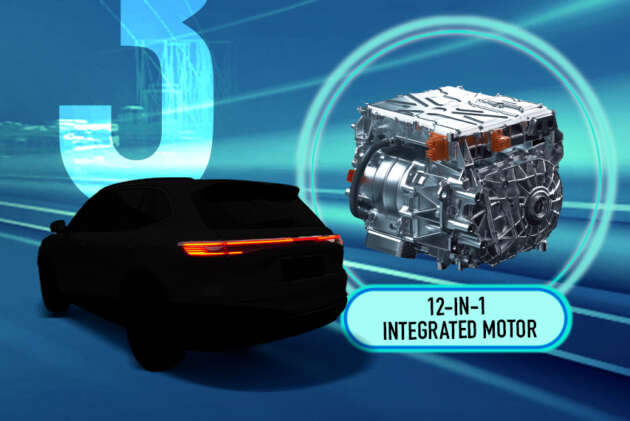
    This juices an Aegis short blade lithium iron phosphate (LFP) battery (which can, of course, be recharged through the mains) that, in turn, powers an electric motor at the front. The latter is housed in a 12-in-1 single-speed dedicated hybrid transmission (DHT), mostly letting the motor drive the wheels on its own. However, it also has the ability to engage a clutch and feed in the four-pot’s power at higher speeds where the petrol engine is more efficient, similar to Honda’s e:HEV hybrid system.

    Geely Starray EM-i

    The specifics will depend on which version of the powertrain we’re getting. In China, the Starship 7 has been newly revised with a more efficient engine – achieving a record thermal efficiency of 47.26%, albeit still making 111 PS and 136 Nm of torque – that enables the car to hit a fuel consumption figure as low as 3.15 litres per 100 km (down from 3.75 litres per 100 km previously) even with a low battery charge.

    Also added is a more powerful 238 PS/262 Nm electric motor, and while there’s still a 19.09 kWh battery delivers a CLTC electric-only range of up to 135 km, buyers now get the option of a 29.8 kWh unit that boosts this figure to 200 km. Total range is thus rated at 1,575 km.

    It’s a different story for global markets, which instead gets a further detuned 99 PS/125 Nm engine and a slightly less powerful 218 PS/262 Nm motor. That’s still enough to get it from zero to 100 km/h in eight seconds flat, but with a slightly smaller 18.4 kWh battery, EV range has shrunk to 83 km and overall range to 943 km, although these figures are on the far stricter WLTP cycle.

    Proton eMas 7 PHEV teased, set to debut at Proton Tech Showcase, COE, Dec 5-7 – 83 km EV, 943 km total

    The Proton eMas 7 PHEV has already been spied testing in Malaysia

    More impressive is the fuel consumption figure of just 2.4 litres per 100 km with a full battery charge. It’s likely that this is the version that us Malaysians will get, given that it has already been homologated for export markets and converted to right-hand drive. But we can still hope, no?

    The eMas 7 PHEV will be largely similar to the electric eMas 7 on the outside, save for split headlights with a full-width light bar, conventional door pulls instead of flush pop-out ones, different bumper and tailgate designs and the aforementioned taillights. Left-hand-drive Geelys also got a redesigned interior, but RHD versions retain the EV’s cabin to simplify the conversion, and we expect the same for the Proton.

    If you want to check out the eMas 7 for yourself, you may do so as the Proton Tech Showcase is open to the public. Again, it’s happening at the COE showroom this weekend, December 5 to 7, from 9am to 5pm on Friday and from 10am to 5pm on Saturday and Sunday.

    GALLERY: Proton eMas 7 spyshots


    GALLERY: RHD Geely Starray EM-i at GIIAS 2025


  • Proton eMas 7 PHEV spied again in Malaysia – 943 km combined range; national brand’s first plug-in hybrid

    Proton eMas 7 PHEV spied again in Malaysia – 943 km combined range; national brand’s first plug-in hybrid

    The Proton eMas 7 PHEV has been sighted in public once again, this time through an image posted to the Proton eMas 7 Owners Malaysia Facebook group by an anonymous group participant. This latest sighting comes almost two weeks since the last sighting earlier this month.

    The eMas 7 PHEV, like its battery-electric relation, goes by different names depending on the market it enters. Known as the Galaxy Starship EM-i in China, the plug-in hybrid SUV is known as the EX5 EM-i in Australia, and as the Starray EM-i in Indonesia where it made its debut in July this year.

    Referencing the Australian-market model, the powertrain for the plug-in hybrid SUV is a 99 PS/125 Nm 1.5 litre BHE15PFI internal combustion engine and a 218 PS/320 Nm electric motor, the latter drawing from an 18.4 kWh LFP battery. Claimed 0-100 km/h time is eight seconds, with a 170 km/h top speed.

    Proton eMas 7 PHEV spyshots, November 2025

    Claimed range is 943 km combined, or 84 km of EV-only range (both figures WLTP), while consumption figures are 2.4 litres per 100 km and 14.7 kWh per 100 km. Charging the EX5 EM-i can be done at up to 7 kW AC, and 30 kW DC, while also being capable of 6 kW V2L power supply. Luggage capacity is 428 litres, or up to 2,065 litres with the rear seats folded.

    In terms of safety features, the model Down Under gets AEB, ACC, ICC, rear cross traffic alert and brake, lane keep assist, traffic sign recognition, door opening warning, lane changing assist, blind spot detection, emergency lane keeping assist, occupant detection alert and driver fatigue alert.

    Australian-market Geely Starray EM-i (RHD)

    Geely Starray EM-i makes ASEAN debut at GIIAS (RHD)

    Geely Galaxy Starship 7 EM-i at Auto Shanghai 2025 (LHD, different interior)


  • 2026 Geely Galaxy Starship 7 in Guangzhou – 200 km EV range, upgrades coming to Proton eMas 7 PHEV?

    2026 Geely Galaxy Starship 7 in Guangzhou – 200 km EV range, upgrades coming to Proton eMas 7 PHEV?

    It’s been barely a year since the Geely Galaxy Starship 7 – sold globally as either the Starray EM-i or the EX5 EM-i – went on sale in China, but the plug-in hybrid SUV is already in for its first mid-cycle refresh, debuting at the ongoing Auto Guangzhou show. This update is significant because a larger battery is helping the car deliver an even more impressive range purely on electric power alone.

    Geely’s efficiency-biased EM-i powertrain is largely the same, but the 1.5 litre BHE15PFI naturally-aspirated four-cylinder engine has been upgraded to the version found in the A7 and the Starshine 6, achieving the world’s highest thermal efficiency of 47.26%. Outputs are still identical at 111 PS and 136 Nm of torque, although the P3 electric motor integrated into the 11-in-1 single-speed dedicated hybrid transmission (DHT) now produces 238 PS and 262 Nm – 20 PS up on the previous model.

    Presumably, this updated motor is also more efficient, because while the 19.09 kWh Aegis short blade lithium iron phosphate (LFP) battery remains the same, the car delivers slightly more electric range at 130 km on China’s more lenient CLTC cycle (135 km with aero wheels and an active grille shutter). This is now the standard version, so no more 55 km 8.5 kWh base battery for 2026.

    2026 Geely Galaxy Starship 7 in Guangzhou – 200 km EV range, upgrades coming to Proton eMas 7 PHEV?

    Even bigger news is the optional 29.8 kWh Golden Brick pack that enables the Starship 7 to travel up to 200 km on a single charge, contributing to a total range of 1,575 km – an increase of 155 km from before. This battery also enables faster DC charging, taking five minutes less to charge from 30 to 80% (15 minutes).

    Beyond that, the Starship 7 gains a new Starry Blue exterior paint option – which is darker than the previous Glacier Blue – and a Starship Grey interior; there’s also a larger 15.4-inch infotainment display (up from 14.6 inches), still running on the Flyme Auto infotainment system. Also new is the G-Pilot H3 suite of driver assists, enabling highly-automated highway and city driving and remote parking assist. A new blue light in the door mirrors indicates when the car is being driven autonomously.

    2026 Geely Galaxy Starship 7 in Guangzhou – 200 km EV range, upgrades coming to Proton eMas 7 PHEV?

    Incidentally, the updates are coming to the Starship 7 immediately after spyshots of its Malaysian twin, the Proton eMas 7 PHEV, began circulating on social media. This raises the question about whether our version will receive the same tweaks – after all, the eMas 5 got the minor design changes of the 2026 Xingyuan, just days after the latter was launched in China.

    However, while Malaysia was the first country outside China to receive the eMas 5/Xingyuan/EX5, things will be different this time around, as Proton is late to the party. The Starray EM-i has already been launched in Indonesia and Australia – with the smaller battery and a detuned version of the old engine, no less – so it’s likely we’ll receive the international spec instead. But hey, we can but dream, right?


  • Proton eMas 7 PHEV first spyshots – 1.5 BHE15PFI + e-motor, 943 km range, launch in Malaysia next year?

    Proton eMas 7 PHEV first spyshots – 1.5 BHE15PFI + e-motor, 943 km range, launch in Malaysia next year?

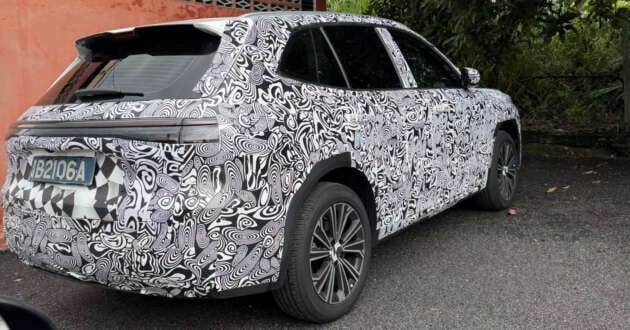
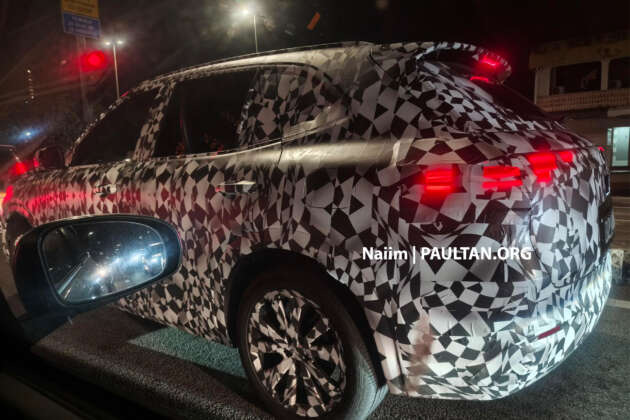
    Why would a Proton eMas 7, launched in Malaysia for nearly a year now, need to be camouflaged? Only one possible reason – this has got to be the plug-in hybrid (PHEV) version. Those alloys certainly don’t look like the Prime’s nor the Premium’s; they look more like the multi-spokers on the Geely EX5/Starray/Galaxy Starship 7 EM-i, which is, yes, the PHEV. We thank reader Naiim for these spyshots.

    The eMas 7 PHEV name was trademarked as early as September 2024. If this happens, it will be Proton eMas’ first PHEV. What can we expect? Well, Australia gets a 99 PS/125 Nm 1.5 litre BHE15PFI (recognise this?) engine, a 218 PS/320 Nm electric motor, an 18.4-kWh LFP battery, an eight-second 0-100 km/h time and a 170 km/h top speed.

    Other figures include WLTP ranges of 84 km on electricity only or 943 km combined, a 2.4 litre per 100 km claimed fuel consumption, a 14.7 kWh per 100 km claimed electricity consumption, max 6 kW AC and 30 kW DC charging, 6 kW vehicle-to-load (V2L) as well as a 428-litre boot that becomes 2,065 litres when you fold the back seats down.

    There are two variants Down Under. Standard are 225/55R18 tyres, a 10.2-inch digital instrument panel, a 15.4-inch centre touchscreen, wireless Apple CarPlay/Android Auto, six speakers, auto climate control and powered front seats. The higher variant gets 235/50R19 tyres and adds a panoramic sunroof, a 13.4-inch head-up display, wireless charging, 16 1,000-watt Flyme speakers, a power tailgate, front parking sensors, 256-colour ambient lighting, ventilated front seats and driver seat memory.

    Safety? Both variants in Australia get AEB, ACC, ICC, rear cross traffic alert and brake, lane keep assist, traffic sign recognition, door opening warning, lane changing assist, blind spot detection, emergency lane keeping assist, occupant detection alert and driver fatigue alert.

    As per the Starship 7 – the original car – there are end-to-end front and rear light bars, split headlamps and regular pull-type door handles, but left- and right-hand drive interiors are not the same – the RHD one is basically the eMas 7’s, which should make things easier for Tanjong Malim when it starts churning this out. Launch bila? Next year’s a good guess, don’t you think?

    Australian-market Geely Starray EM-i (RHD)

    Geely Starray EM-i makes ASEAN debut at GIIAS (RHD)

    Geely Galaxy Starship 7 EM-i at Auto Shanghai 2025 (LHD, different interior)


Latest Fuel Prices

PETROL
BUDI 95 RM1.99
RON 95 RM3.87 (+0.60)
RON 97 RM5.15 (+0.60)
RON 100 RM6.90
VPR RM7.88
DIESEL
EURO 5 B10 RM5.52 (+0.80)
EURO 5 B7 RM5.72 (+0.80)
Last Updated Mar 26, 2026

Latest Videos


Related PaulTan.org Content: Malaysia: Malaysia | 2025 | Electric: Electric | Featured: Featured | Motorsports | Tech