
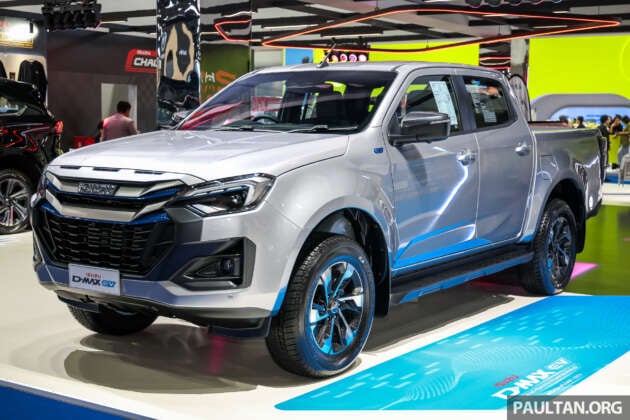
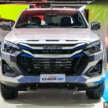
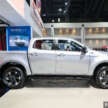
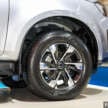
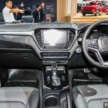
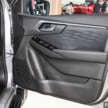
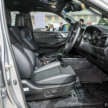
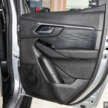
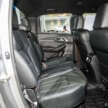
Here’s a live gallery of the new Isuzu D-Max EV that is currently on display at the ongoing Bangkok International Motor Show (BIMS). The fully electric pick-up truck was first revealed in production guise back in April last year after previously being previewed as a concept in 2024, and it received official pricing in Thailand just a few days ago.
Offered in a sole double-cab variant, the D-Max EV retails for 1.591 million baht (about RM192k), making it the most expensive version of the D-Max available in Thailand. Combing through Isuzu’s Thailand website, the only variant of the diesel-powered D-Max that comes close in terms of pricing is the double-cab V-Cross with a 3.0 litre engine and automatic transmission priced at 1.297 million baht (RM157k).
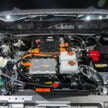
The D-Max EV comes with a dual-motor powertrain, with the front electric motor rated at 58 PS (58 hp or 43 kW) and 108 Nm of torque. Meanwhile, the rear e-motor provides 132 PS (130 hp or 97 kW) and 217 Nm for a combined system output of 190 PS (188 hp or 140 kW) and 350 Nm.
For context, the 4JJ3-TCX makes the same amount of power – 190 PS (188 hp or 140 kW) – but offers more torque at 450 Nm. Even the lower-displacement RZ4F-TC 2.2 litre Ddi MaxForce turbodiesel provides more twisting force at 400 Nm, although its max power output is less a 163 PS (161 hp or 120 kW).
Powering the e-motors is a 66.9-kWh lithium-ion battery that enables range of up to 331 km following the NEDC standard, or 263 km with the WLTP cycle. For charging, the zero-emission pick-up truck will accept an AC input of up to 11 kW (0-100% in 10 hours), while DC fast charging is at a peak of 50 kW (20-80% in one hour). Drivers also have four levels of regenerative braking to choose from.
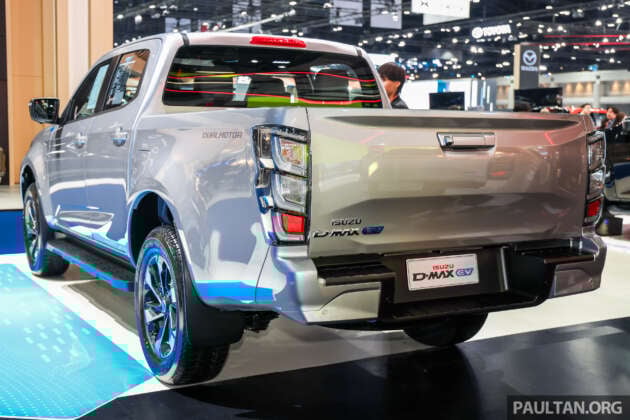
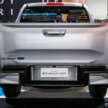
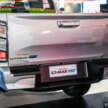
Visually, the D-Max EV looks pretty much identical to its diesel-powered siblings, with design cues identifying it as an electric vehicle being the blue accents on the grille as well as the ‘EV’ badges and ‘Dual Motor’ text on either side of the bed. Peak underneath and you’ll spot the protective plate for the battery that occupies most of the unchanged 3,125 mm wheelbase, while a De Dion rear suspension replaces the leaf spring configuration of the diesel-engined D-Max.


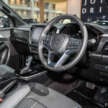
As for equipment, the D-Max EV comes with bi-beam LED projector headlamps, LED fog lamps, LED taillights, a seven-inch multi-info instrument cluster display, a nine-inch infotainment touchscreen, wireless Android Auto and Apple CarPlay support, eight speakers, an eight-way powered driver’s seat, dual-zone climate control with PM2.5 filtration, a 360-degree camera, the usual array of passive safety systems as well as front and rear parking sensors.
A comprehensive ADAS suite is also standard and includes adaptive cruise control, forward collision warning, autonomous emergency braking, lane departure warning, lane departure prevention, lane keep assist, traffic jam assist, pedal misapplication mitigation, manual speed limiter, automatic high beam, multi-collision brake and turn assist with AEB.
Each D-Max EV comes with a five-year/100,000-km vehicle warranty, while the battery is guaranteed for eight years or 160,000 km. The electric pick-up truck is assembled locally (CKD) at Isuzu’s Samrong plant in the Samut Prakan province.




Looking to sell your car? Sell it with Carro.





EV version of an existing designed ice platform pickup is extremely inefficient on battery power firstly the high drag coefficient of the wind hindrance body and the under floor pan. Frequent charging and short distance range.
260km range , if carry a full payload will become around 200km range.
Main worry is parking it overnight in the car porch. There’s is no plan B if it catches fire while your entire family is deep in sleep upstairs (double storey terrace). Best case is everyone get to escape, but u still have to watch your entire house burn down because we can’t stop the thermal run away
I like your dedication to copy paste same comments every EV article
the money must be good because anyone would be very dedicated to spam too if paid well