

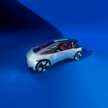
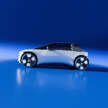
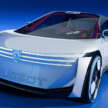
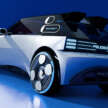
Peugeot has unveiled the Polygon concept, with which the French manufacturer claims it is “reinventing the wheel” with its introduction of its Hypersquare rectangular steering “wheel” that steers the vehicle through electronic steer-by-wire inputs. Measuring less than four metres in length, the Polygon concept is said to preview future models from the manufacturer with the aforementioned technologies.
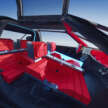
Said to represent the manufacturer’s new generation of i-Cockpit, the steer-by-wire configuration of the Hypersquare steering input enabled the designers to do significantly alter the shape of the dashboard, with the wheel situated high on the dashboard, while instrumentation is projected to the windscreen on a display area measuring 24 cm tall by 74 cm wide, or equivalent to a 31-inch screen, says Peugeot.
The Hypersquare steering wheel operates on a speed-dependent steering ratio, where low speeds such as when parking the vehicle will see the steering ratio quickened to easily allow sharp turns without the driver having to move their hands from their positions, enabling a steering rotation of 170 degrees in each direction, or less than a full turn in total.


Combining the Hypersquare wheel and steer-by-wire will offer response and precision at high speeds, along with “a unique sense of hyper-agility”, said Peugeot.
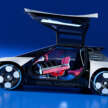
The Polygon concept also brings a new seat design that combines a 3D-printed shell with a single piece of moulded foam, which Peugeot says allows for the creation of new shapes and a more geometric design that is otherwise limited by traditional, fabric-covered seat designs.
The seat foam can be replaced in minutes for a unit of a different colour or of a different shape, while the Hypersquare steering wheel, customisable dashboard elements as well as wheel covers can also be easily replaced whenever the mood strikes, says Peugeot.


While the Polygon concept takes on the form of a hatchback, suggesting a successor to the 208 model equivalent, the concept here employs “XXL”-sized gullwing doors instead of the more typical four-door layout, which the carmaker says aids in entry and egress while simplifying component design and manufacturing, thus reducing the number of parts required.
The wheel covers are made of recycled plastic, and are each produced as a single piece through 3D printing; the example shown are also mirror the four-circle design of the concept’s Hypersquare steering wheel.
Peugeot’s mention of the Polygon concept being a showcase for innovations that it will introduce from 2027 onwards suggests that elements from the concept will emerge on the successor to the current 208, which is due to be replaced around that time, according to Autocar.
The publication stated that the next 208 will be the first model to use the Stellantis STLA Small architecture, and this upcoming model is said to no longer offer the choice of an internal combustion engine, indicating that the 208 successor will be EV-only.


















Looking to sell your car? Sell it with Carro.







So while we’re dealing with the farce of an unnecessary feature such as Tesla’s hidden electronic door handles that have no mechanical connection to the physical locks, causing deaths in accidents, here we have another group of geniuses who have decided that the steering wheel does not need mechanical connection to the wheels. What could possibly go wrong.
its not actually a new concept , infiniti q50 many years ago already had steer by wire feature. so did anything do wrong?
infiniti Q50 had steer by wire years ago, did anything go wrong?
successor to the 208 model – We Malaysian kinda gave up on 208 long time now. Not expecting Peugeot Malaysia will ever sell this category here. A*****es!
say no to unreliable peugeot with EP6DT engine always leaking oil , turbo kong, oil pump water pump kong, timing chain tensioner spoil, aircon compressor spoil , cooling coil leak, gearbox fault, depollution fault, speed sensor spoil .